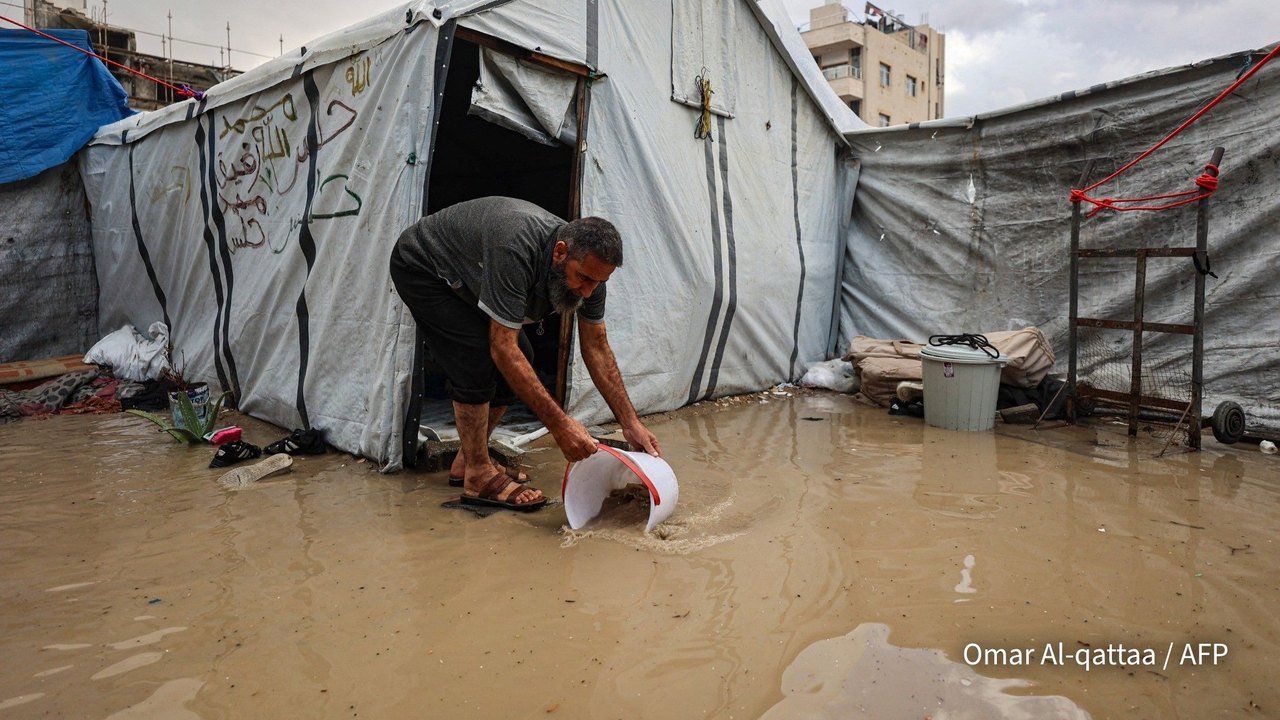
At a tent encampment in Gaza City on Saturday, Olfat Magdoub, a Gaza resident, tried in vain to sweep water away from her tent, Reuters reports. “This is the first day of rain, and of course we are already flooded. What will happen if it rains again the next day?” she told the agency. Elsewhere in the same Reuters report, Rafiq Ghattas, a displaced Gaza resident, stood barefoot in the middle of a large pool of rainwater: “We have no resources, no tarpaulins, no tents and no one is checking on us.” At the Gaza City encampment, Reuters says, some people patched their tents, others piled sand against the walls to hold the water back, and some worked to get their children out of flooded tents.
Scenes like those repeated across the Strip, by the count of Gaza’s own authorities. The Hamas-run Government Media Office says about 70,000 tents flooded within roughly 12 hours of the season’s first winter storm, Al Jazeera reports, and puts initial losses at about $3 million — a figure Xinhua also carries from the office. Reuters words it as “at least 70,000 tents” in the past 12 hours, affecting tens of thousands of displaced people. No outlet this desk read made an independent tally, so the 70,000 figure stays the office’s claim. For scale, the Palestinian news agency WAFA estimates that about 270,000 tents shelter displaced families across the territory, which would put roughly one in four under water if both numbers hold — a calculation by this desk, not by either source.
The rain started the night before. In al-Mawasi, the coastal strip where Al Jazeera says more than 900,000 displaced people shelter in southern Gaza, it had fallen since 10 p.m. Friday local time (20:00 GMT, noon PT Friday, Nov. 6), Al Jazeera’s Rami Abu Taima reported from Khan Younis. “People woke up to find hundreds, even thousands, of tents flooded across the Gaza Strip,” he said, adding that more than 125,000 families living along the coast faced a particular risk of the sea sweeping their tents away, according to Al Jazeera. AFP reports hundreds of families seen fleeing camps in parts of Gaza City and in central and northern Gaza from early Saturday.
Gaza’s civil defence agency describes crews swamped and short of gear. Spokesman Mahmoud Basal (spelled Bassal by AFP) told Al Jazeera: “What we feared has actually happened.” He told AFP the agency “is operating without any equipment or capabilities,” and added: “We cannot face the consequences of this storm on our own.” Al Jazeera says the agency counted about 1,500 distress calls in the first 10 hours and water rising 30 to 40 centimetres (12 to 16 inches) at several shelter sites; a later civil defence statement, as Xinhua reports it, puts the call count at 2,166 since the storm began — with crews able to reach only 218 — and says water reached 1.5 metres in some residential areas, a far higher figure than the earlier one. Raed al-Dahshan, Gaza’s civil defence director, told Al Jazeera: “Civil defence does not have a single tarpaulin or a single tent.” Municipal and civil defence officials told Reuters they could not cope because of fuel shortages and damaged equipment, and said Israel had destroyed hundreds of vehicles, including bulldozers and others used to pump water, during the war.
Watch: families clear water from flooded tents, in TRT World and Viory footage on X
If an embed does not load, it shows as a plain link to the original post. The clips add pictures to, and do not replace, the Reuters, AFP, Al Jazeera, BBC and COGAT material above.
View the @trtworld post on X
View the @vioryvideo post on X
Accounts of damage to buildings differ in scale. The media office cites the “collapse of dozens of cracked walls and roofs, which caused injuries,” some of them critical, according to AFP and the BBC; Xinhua renders the same office’s injuries as “of varying severity, some of them serious.” Reuters quotes civil defence saying three abandoned houses collapsed without causing injuries, and says the office reported no deaths. WAFA reports that two people suffered injuries in northern Gaza when a wall of a building previously damaged by Israeli bombardment fell in the rain, and Al Jazeera says rescuers evacuated residents of a partly collapsed building in central Nuseirat.
Families who spoke to AFP described the same night from inside the tents. Um Muhammad al-Hersh, 45, who lives with her family in a tent in western Gaza, said: “We were not able to save the mattresses, and all the clothes were soaked. Our suffering is repeated every winter.” Maryam Odeh, 34, who lives with her children in Deir el-Balah, said: “We no longer know how to protect our children. My children ask me where we will sleep tonight, and I have no answer.” Khaled al-Najjar, 41, told the agency: “We fear for our children not only from the flooding of the tents, but also from the cold and the widespread diseases.” The BBC also carries the Odeh and al-Najjar quotes, credited to AFP, and The Hindu runs the AFP report.
Medical staff and the UN children’s agency warn about what comes next. Mohammed Abu Salmiya, director of al-Shifa Medical Complex in Gaza City, told Al Jazeera that the hospital’s emergency department flooded and stayed out of service for about four hours, and warned of rising gut, respiratory and skin infections as sewage mixed with rainwater in tents. “We will see many deaths, in the dozens and perhaps the hundreds, among newborns who need warmth in these tents,” he said — a forecast, not a count. UNICEF’s Jonathan Veitch told the BBC: “We saw last year what winter does, and we had deaths from hypothermia last year.” He said aid teams got “stopped on the street” by people begging for help, and that “heavy flooding this morning means that nearly everyone needs help.”
Palestinian officials put the blame on Israel. The media office held Israel “fully responsible” for what it called a disaster caused by closed crossings and blocked shelter and reconstruction materials, Al Jazeera reports, and the Palestinian Presidency said Israeli authorities bear responsibility for “the worsening humanitarian catastrophe,” per Al Jazeera English on X. Mustafa Qazzaat, a Gaza City council member on the Strip’s emergency committee, told AFP that Israel has let in no prefabricated homes since the truce and only limited numbers of tents, and that Gaza “needs 200,000 prefabricated homes urgently.” Mohammed Salha of the Palestinian NGO Network told Al Jazeera that only 180 to 200 trucks enter Gaza daily against 600 agreed under the ceasefire’s humanitarian protocol, about 40 of them carrying humanitarian aid, and that 50,000 tents sit waiting on the Egyptian side of the border.
Israeli officials frame the shortfall differently. A day before the storm, COGAT, the Israeli military agency that coordinates aid, as Reuters describes it, wrote on X: “Ahead of the upcoming rainfall, COGAT continues to intensify its efforts to improve sanitation conditions across the Gaza Strip, in coordination with the international community.” The post lists four more vacuum trucks brought in through the ICRC that week, eight in the month before, and weekly waste removal from 11 designated disposal sites. A Nov. 5 COGAT post says the agency “proactively prepared to bring winter supplies into the Gaza Strip.” Reuters says COGAT did not immediately comment on Hamas blaming Israel, and the BBC notes that Israel says it restricts the entry of items that could serve military purposes. The Israeli site WireIsrael quotes an unnamed Israeli security official saying: “As long as Hamas remains armed, Gaza will not be rehabilitated, and residents will continue to live in tents.” WireIsrael also attributes to COGAT a tally of about 8,200 trucks carrying more than 91,000 tents and other winter gear since Israel’s winter plan began; this desk could not find that COGAT statement itself, so the figure stays WireIsrael’s report.
The storm lands in a stalled peace process. A ceasefire took effect on Oct. 10, 2025, according to AFP, which says Israeli airstrikes and ground operations have continued on an almost daily basis since; Reuters says the U.S.-brokered deal called for eventual reconstruction but that little has happened, with negotiators unable to agree on Hamas disarming or Israel withdrawing troops that, Reuters says, control about two-thirds of the territory. Gaza’s Hamas-run health ministry counts 74,594 people killed since the war began, including 1,580 since the ceasefire, the BBC reports, noting that the UN considers the ministry’s figures reliable; the war began with the Hamas-led attack of Oct. 7, 2023, in which about 1,200 people died and 251 people got taken hostage, the BBC says. Al Jazeera notes that many of the tents went up in the first year of displacement and now stand in their fourth, patched and re-stitched by their owners.
What would sharpen this picture: an independent count of damaged shelters from UN agencies; a direct COGAT response on shelter and caravan entry; and more rain forecasts for the coast, where Al Jazeera’s Ghazi al-Aloul said from Gaza City port that “these tents will flood first from the rain, and second from seawater.” Olfat Magdoub told Reuters that after rain two weeks earlier she spent four days sleeping on blankets spread on the floor. “Same now, the mattresses are wet so we sleep on the ground.”