The United States has formally tagged helium, the light, nonrenewable gas best known for party balloons, as a critical material. The Energy Department announced on Oct. 23 that Secretary Chris Wright had designated helium under the Energy Act of 2020, citing what the department calls its “essential role in American manufacturing and growing exposure to supply chain risks” (DOE release). A notice prepared for the Federal Register, signed Oct. 21 by Assistant Secretary Audrey Robertson, puts the gas on the department’s Critical Material List (DOE notice).
The department’s own case rests heavily on chips. The notice describes helium as “non-substitutable for multiple critical energy functions, including: semiconductor manufacturing, leak testing natural gas infrastructure, and quantum computing, along with being essential to key medical/scientific applications.” It adds that demand keeps growing because helium enables advanced semiconductor manufacturing, which the notice links to SI and data-center supply chains (DOE notice). The notice also ties the move to two executive orders: one from January 2025 on artificial-intelligence infrastructure and one from October 2026 titled “Inaugurating the Era of Super Intelligence” (DOE notice).
What the label changes in practice seems modest but real. CBS News, Euronews and AP all report that the designation makes more federal financing available to helium producers, and Euronews and AP add that it puts the gas under closer government monitoring (CBS News; Euronews). Under the 2020 law, a critical material must face a high risk of supply disruption and serve an essential function in energy technology, CBS notes. The department’s release says “limited refining capacity and lengthy permitting timelines continue to constrain U.S. production,” even though the country holds “significant domestic deposits of helium-rich natural gas” (DOE release).
Wright framed the step as industrial policy. “President Trump is bringing back America’s manufacturing industry, and that means making sure we have the materials needed to build things in America again,” he said, adding: “Helium is essential to producing the semiconductors and advanced technologies that power our economy” (DOE release). Robertson said the department aims to give American manufacturers “reliable access to helium as a critical resource they need.”
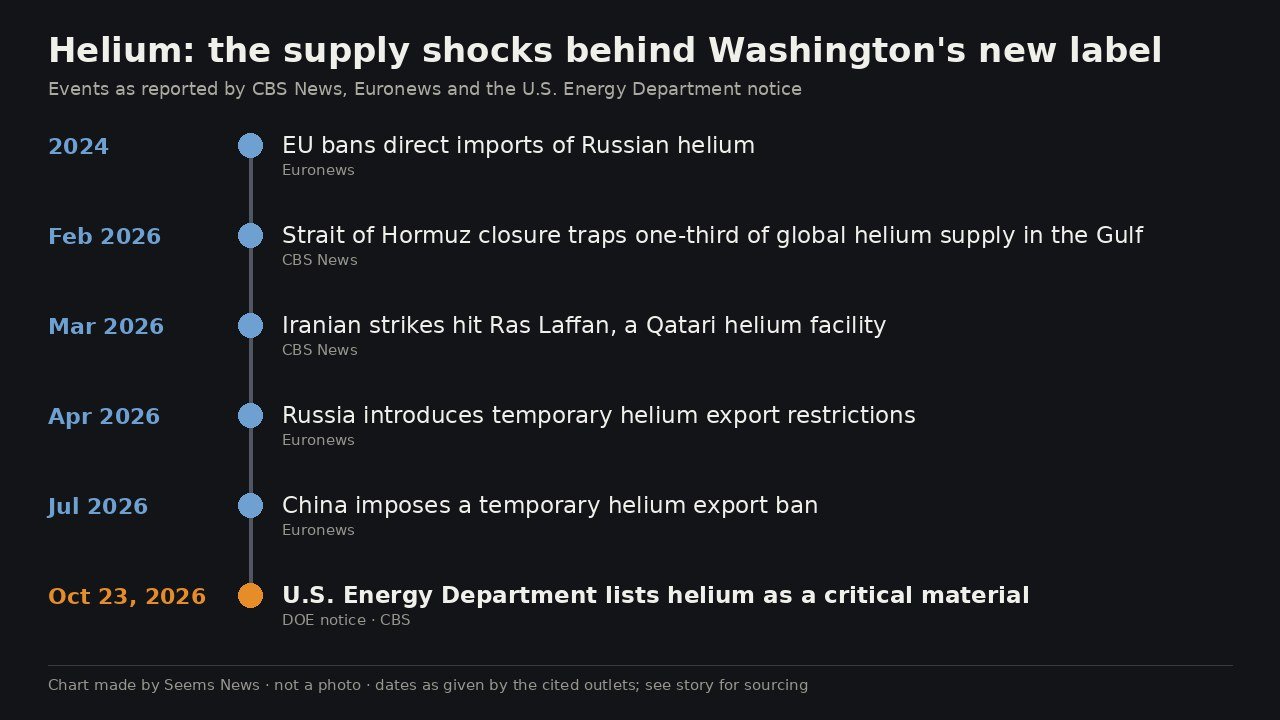
The timing follows months of disruption abroad. Helium comes mainly as a byproduct of natural-gas processing, and the United States leads the world in producing both, with Qatar and Russia among the other top producers, according to AP and Euronews. CBS News reports that the closure of the Strait of Hormuz in February “trapped one-third of the global helium supply in the Persian Gulf,” and that Iranian strikes in March hit Ras Laffan, a Qatari facility that produces helium (CBS News). CBS says a range of industries have felt a shortage since then, and notes that the designation came days after a 60 Minutes report on the war’s effect on helium supply.
Europe seems more exposed. Euronews reports that Russia introduced temporary export restrictions in April to protect its home market, and that China imposed a temporary export ban on the gas in July (Euronews). China produces little helium itself but has served as a transit route for Russian supplies reaching Europe, Euronews says, citing a July Financial Times report; the EU banned direct imports of Russian helium in 2024, yet some supply reportedly kept flowing through China. This desk did not read the Financial Times report.
Helium joins a short list. DOE’s 2023 list of critical materials for energy names 18 items, from aluminum and cobalt to silicon carbide, and the department added metallurgical coal for steelmaking in May 2025, according to the notice (DOE notice). CBS counts 20 designated critical materials now, which matches this desk’s tally. The department’s broader list also folds in the Interior Department’s critical minerals, which the U.S. Geological Survey compiles, according to the notice; the count of 20 covers only the materials the Energy Department names for energy.
The documents leave some questions open. The department rests its case on chipmaking and data centers, which depend on a gas with “no viable substitutes in many critical applications,” as the DOE release puts it. Yet neither the release nor the notice puts a dollar figure on the new financing, names any producer that will benefit, or sets out what closer monitoring involves; this desk found no such detail in the documents it read.
This desk read the Energy Department notice (PDF) and press release, and reports from CBS News and Euronews. AP’s page timed out for this desk, and The Washington Post’s copy of the AP story did not get read in full; the AP points above rest on its summary lines as they appear in search results and match what CBS and Euronews report. The chart above lists dates from those reports and shows no photo.