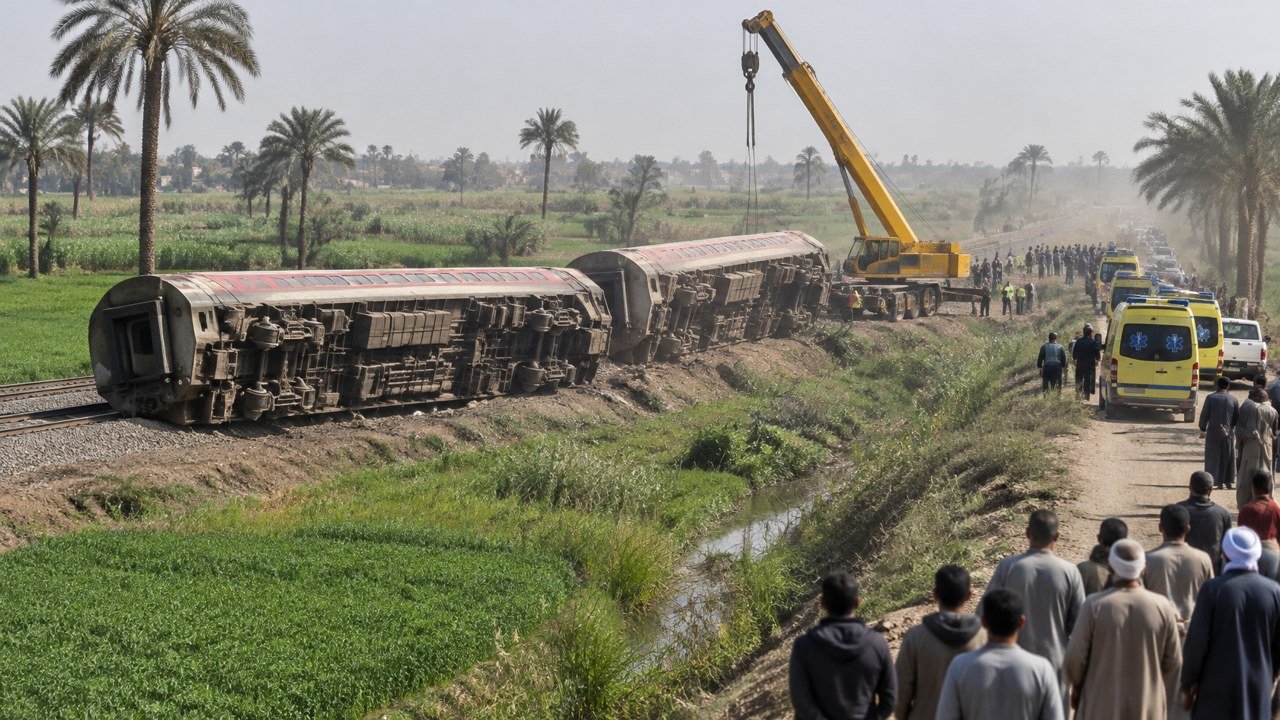
Two passenger trains collided on Sunday in Egypt’s Giza governorate, south of Cairo, and Egypt’s health ministry put the toll at seven people dead and 112 injured, Reuters reports. The state railway authority, Reuters says, reported that a train travelling from Giza to Fayoum hit the back of another train heading from Cairo to Aswan, derailing several carriages. AFP, in a report carried by Arab News, gives the same seven dead and 112 injured, citing authorities, and says the crash happened in the al-Ayyat area of Giza. The BBC reports that several carriages derailed and fell down an embankment, and that images from the scene showed people looking inside overturned carriages for injured passengers.
The railway authority named both trains. APA, citing Ahram Online, reports that the Egyptian National Railways said train No. 134, a Tahya Misr service on the Giza–Fayoum route, collided with the rear of train No. 2010, which ran from Cairo to Aswan, between Kafr Ammar and Al-Raqqa stations. Al Manassa, citing a Ministry of Transport statement, gives the same train numbers and says the impact derailed four carriages, overturned them and halted traffic in both directions on the Upper Egypt line. Al-Masry Al-Youm places the collision near the village of Al-Raqqa in al-Ayyat district (desk translation).
Prosecutors added the sequence. The Public Prosecution Office, after inspecting the scene and speaking to eyewitnesses, determined that the front of the Giza–Fayoum train crashed into the back of the Cairo–Aswan service, which had stopped on the tracks, the BBC’s live page reports. The same statement, the BBC says, put the initial toll at seven dead, including the driver of the Giza–Fayoum train, and 114 injured, slightly above the health ministry’s 112. AP reports that the Chief Prosecutor’s office said the train’s conductor died; this desk could not open AP’s full text and records the driver-versus-conductor wording as a translation gap rather than as two different victims.
The count rose through the afternoon. The health ministry first reported four dead, including a train driver, and 88 injured, the BBC reports, before raising the figures to seven and 112 in an update the BBC timestamps at 16:30 GMT (8:30 a.m. PT). The ministry also said 45 people sent to hospital had gone home, the BBC adds. Al Manassa, in a report written at the four-and-88 stage, says the local site Masrawy cited an anonymous source who put the injured at around 150, a figure the source called preliminary; no official count this desk found reached that number. AFP, via Arab News, notes that state-owned media earlier reported 120 injuries without saying how serious they looked.
Watch: the crash site in al-Ayyat, from CBS News and Channel 4 News
If an embed does not load, it shows as a plain link to the original post. The clips add pictures and sound to, and do not replace, the Reuters, BBC, AFP, AP, Ahram Online, Al Manassa and Al-Masry Al-Youm reports above. Both posts went out at the earlier four-dead stage, before the health ministry raised the toll to seven.
View the @CBSNews post on X
View the @Channel4News post on X
Hospitals in two governorates took the wounded. APA, citing Ahram Online, says 72 ambulances took part in evacuation and that Health Minister Khaled Abdel-Ghaffar ordered facilities in Giza and Beni Suef to raise their readiness. Al-Masry Al-Youm, in its latest tally, lists 72 injured taken to Al-Wasta Central Hospital, 33 to Al-Ayyat Central Hospital and seven to Atfih Central Hospital, and seven deaths split three at Al-Wasta and four at Atfih (desk translation); an earlier line in the same article gives a different split, which this desk treats as a leftover from a previous update. The health ministry described injuries that included bruising, fractured limbs, pelvis and vertebrae, and cuts to the head and face, the BBC reports, and added: “The remaining injured are continuing treatment under medical observation.” The Egyptian Red Crescent sent teams from Giza, Fayoum and Beni Suef for aid and psychological support, the BBC says.
The cause remains open. Reuters says the public prosecutor’s office reported investigations underway into the technical reasons behind the crash. The prosecution, in a Facebook statement, said investigators would examine the damaged carriages, the tracks and the surrounding area and look for “shortcomings” in operating procedures and safety measures, the BBC reports. Al Manassa quotes an unnamed official on the board of the Egyptian National Railways as saying authorities had two preliminary scenarios: a fault in the signaling system that may have shown the driver a proceed signal when he should have stopped, or a driver who failed to follow signals and instructions. The official stressed that neither scenario could get confirmation before technical inspections and formal investigations end, Al Manassa reports.
Egypt’s leaders responded within hours. President Abdel Fattah al-Sisi said he had ordered state authorities to “investigate the circumstances of the accident, and hold accountable anyone found to have been negligent,” the BBC reports. AFP, via Arab News, quotes him as following the accident “with great concern.” Prime Minister Mostafa Madbouly called the health, social solidarity and transport ministers about care for the injured, aid for families and clearing the line, APA, citing Ahram Online, reports. Transport Minister Kamel al-Wazir visited the site, the BBC reports, and Al-Masry Al-Youm says Giza Governor Ahmed el-Ansari went with him (desk translation). The BBC’s Youssef Taha writes that some Egyptians called on al-Wazir to resign because fatal crashes keep happening; Al-Masry Al-Youm reports that lawmaker Sanaa El-Said, of the Egyptian Social Democratic Party, filed a parliamentary question to the prime minister and the transport minister about the crash (desk translation).
Passengers and families face practical gaps. Reuters reports that emergency crews worked to clear the wreckage and restore the Cairo–Upper Egypt line, and that the railway authority gave no indication of how long that would take. The transport ministry sent buses between Al-Wasta and al-Ayyat stations and between El-Moneib and al-Ayyat until trains resume, APA, citing Ahram Online, reports. The Financial Regulatory Authority said its chairman, Islam Azzam, told the Railway and Metro Accident Insurance Pool to speed compensation and to raise payouts for deaths and permanent total disability from EGP 30,000 to EGP 50,000, APA reports; Al-Masry Al-Youm describes the raise as exceptional (desk translation). The BBC’s Wael Hussein, reporting from Cairo, writes that lower-income Egyptians ride both services heavily, with tickets under $1 for the Fayoum trip and under $10 for Aswan, and that eyewitness accounts may come slowly because many passengers lack smartphones.
The stretch carries a heavy history. The BBC reports that the collision happened close to the site of Egypt’s deadliest train disaster, a February 2002 fire on a Cairo–Luxor train that officially killed more than 370 people, and that two crashes in the area in 2009 killed dozens more. Reuters puts the 2002 toll at at least 360, and Al Manassa at over 350, so the desk gives the range rather than one number. Al Manassa adds that three crashes in the same area in 2016 killed 14 people, and cites the state statistics agency CAPMAS as recording 170 train accidents in 2025, down from 220 in 2024. Al Jazeera, writing with AFP and AP, says Egypt has poured billions of dollars into highways and high-speed rail but has yet to overhaul much of its older train services.
Reports differ on distance. Reuters places the crash about 76 km (47 miles) south of Cairo, AP about 52 km (32 miles), and the BBC’s live page 73 km (45 miles) south of Giza; this desk does not pick one. What this desk could verify: the health ministry’s seven dead and 112 injured, as carried by Reuters, the BBC, AFP and APA; the railway authority’s train numbers and station names; the prosecution’s finding that a moving train struck a stopped one; the president’s order to investigate; and the compensation increase. Still open: the names of the dead, the condition of the most seriously injured, the cause, and when trains will run again on the Upper Egypt line.