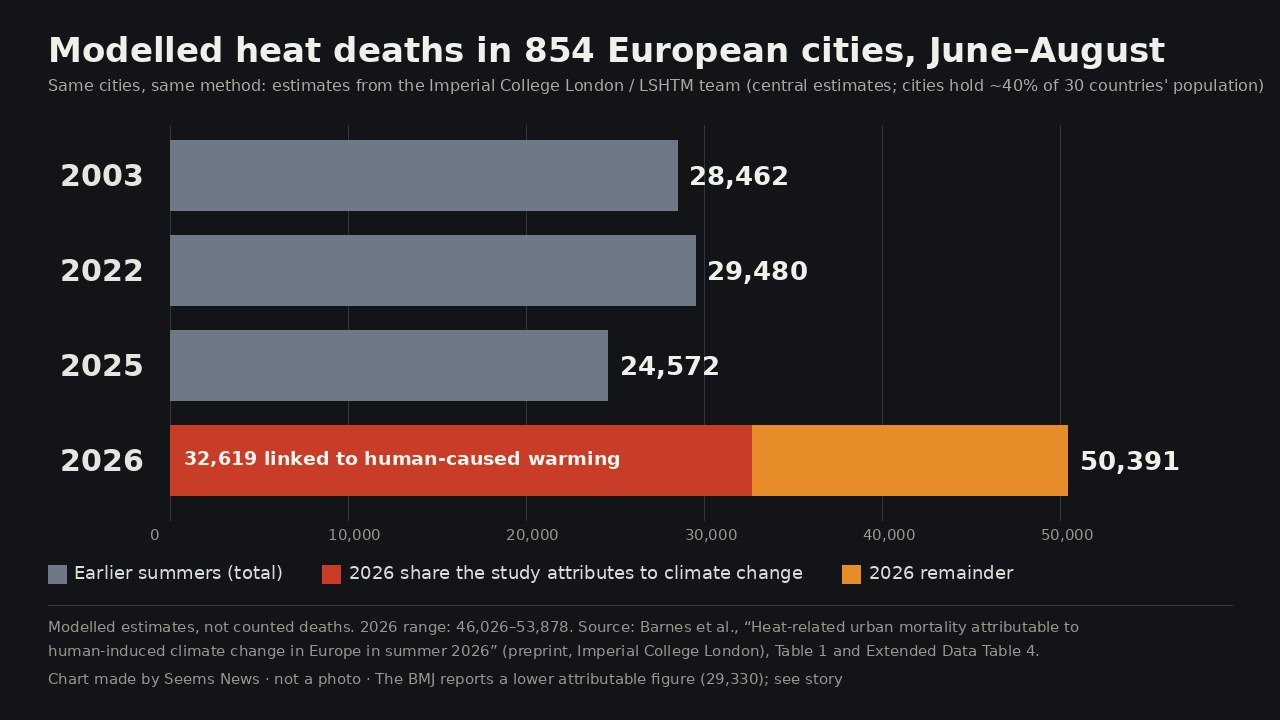
Europe’s record-breaking summer turned deadlier in its cities than any other this century, according to a new estimate. Researchers led by Imperial College London and the London School of Hygiene & Tropical Medicine (LSHTM) calculate that heat caused 50,391 excess deaths in 854 European cities between June and August 2026, and that human-caused warming accounts for roughly two-thirds of them (preprint). Science, which reported the findings on Oct. 22, says Nature Health has accepted the research for publication and calls it the first continentwide death estimate for this summer.
The number comes with a range. The authors give a 95% empirical confidence interval of 46,026 to 53,878 deaths across cities with a combined population of almost 173 million (preprint). They estimate that 32,619 deaths (26,078 to 38,237), or 65%, would not have happened in a world without human-caused warming. Science reports the same rounded figure, 32,600. The BMJ, in a news report published Oct. 23, gives a different attributable count, 29,330 (23,495 to 34,420), while also describing it as “close to two thirds.” The two counts come from different scenarios in the same preprint. Table 1 gives 32,619 under the main analysis. A sensitivity analysis that reuses the mean populations and annual mortality rates from 2000 to 2019, as the earlier estimates for 2003 and 2022 did, gives 45,492 heat deaths for summer 2026 (41,429 to 48,719), of which 29,330 (23,495 to 34,420) count as attributable to human-caused warming; the authors call that total “around 50% higher than in either 2022 or 2003” (preprint). The BMJ sets the 29,330 figure beside the roughly 50,000 main-analysis total without naming the scenario. By this desk’s arithmetic on the preprint’s figures, the two attributable shares come out at about 65% (main analysis) and about 64% (sensitivity analysis).
How the team got there matters. Rather than combing death registers, as national health agencies do, the researchers built a model estimating how many people heat would kill each day in each city, based on the link between heat and excess deaths observed in 232 of those cities from 2000 to 2019, Science explains. They then compared the summer’s observed temperatures with a simulated summer minus human-caused warming. Over all 854 cities, the summer ran about 2.4°C hotter than the 1991–2020 average, with single days up to 7.3°C above normal, the preprint says.
By the authors’ own yardstick, 2026 stands far apart. Running the same method on the same cities, they find 29,480 heat deaths for summer 2022, 28,462 for 2003 and 24,572 for 2025, making 2026 almost double the previous year (preprint). The BMJ calls it the highest estimate in the 26 years analysed. A companion paper in Nature Health, published Oct. 14, used the approach to estimate 430,365 heat-related deaths in the same cities over the summers of 2000 to 2025 (Nature Health).
The oldest Europeans bore most of the toll. The model attributes 22,502 deaths to people aged 85 or older, and Science puts another 14,100 among those aged 75 to 84 (preprint; Science). Even adults aged 20 to 44 account for about 833 deaths, the preprint says. Almost a third of all modelled deaths fell between June 17 and July 1, when city temperatures averaged 5.3°C above the 1991–2020 mean.
Geography shaped the risk. Southern Europe, where dangerous heat persisted from mid-June, shows the highest age-standardised rate, 380 deaths per million people, against 277 in western Europe, 250 in eastern Europe and 129 in northern Europe (preprint). Italy accounts for the largest single-country total, 13,303, and Malta, Italy, Hungary and Croatia show the highest rates. The authors flag Malta’s attribution share as highly uncertain. The estimated share tied to warming tops 50% in every other country.
Outside scientists see the toll as preventable but caution about the method. “Almost all those deaths are preventable,” Kristie Ebi, a climate epidemiologist at the University of Washington who did not take part, told Science; she suspects the model may understate deaths during the most extreme heat. Marcos Quijal Zamorano, an environmental epidemiologist at the University of Bern, called the approach “robust” but said a city’s numbers could drift if its conditions this year differed too much from the 2000–19 baseline, Science reports. Science notes that a study author supervises his postdoctoral work. The authors themselves list reasons the figure may run low, including humid, unusually warm nights during the June heat wave and early-season heat before people had acclimatised (preprint).
National counts point the same way, though they use different methods and periods. Germany’s Robert Koch Institute estimates 16,000 heat-related excess deaths between April 6 and Sept. 6, Spain’s mortality monitoring system reports 5,123 between June and August, and Santé Publique France reported 5,764 between June 17 and July 2, according to the preprint. The BMJ says the UK Health Security Agency estimated almost 2,900 heat-related deaths in England in May and June (The BMJ). The authors call those official figures “broadly consistent” with their modelled estimates once partial coverage gets taken into account.
The lead author framed the result as a warning. “These numbers are a stark reminder that our hotter, more extreme summers are having an increasingly severe impact on public health,” Clair Barnes of Imperial College London’s Centre for Environmental Policy said, according to The BMJ, calling for targeted protection for the most vulnerable and a faster shift away from fossil fuels. Andrew Hartle, an intensive care consultant at Imperial College Healthcare NHS Trust who did not take part in the study, told The BMJ: “Here in the UK the summer is historically the quietest time for our health service. This summer, however, saw demand and strain that was akin to a really bad winter virus season.”
This desk read the authors’ preprint in Imperial College London’s repository, the companion 2000–2025 paper in Nature Health, and news reports from Science and The BMJ. It did not read the final Nature Health version of the 2026 paper: the link The BMJ gives returned an error page (HTTP 404) when this desk tried it on Oct. 23. The chart above uses the preprint’s tables and shows modelled estimates, not counted deaths.
Correction · Oct 23, 2026, 10:01 PM PT: An earlier version of this story said this desk could not reconcile The BMJ’s 29,330 attributable deaths with the preprint’s 32,619. The preprint itself carries the 29,330 figure: it comes from the authors’ sensitivity analysis using 2000–2019 average populations and mortality rates, in which the summer 2026 total comes to 45,492. The main analysis gives 50,391 deaths and 32,619 attributable. The story, key facts and evidence panel now explain the difference.