Pope Leo XIV seems set to need no more cancer treatment after his lung surgery last week. His doctors said on Wednesday, Oct. 21, that final laboratory tests on the tissue removed during the operation confirmed a lung adenocarcinoma and showed the disease had stayed localized, according to Vatican News, the Vatican’s own news service, which says the Holy See Press Office released the statement on Wednesday evening. Vatican News quotes it in full. It opens: “The final histopathology and molecular testing reports on the tissue removed during the Holy Father’s surgery were issued today.” It goes on: “The results confirmed that the tumor was a lung adenocarcinoma and that the disease was localized.” And it closes: “A subsequent oncological assessment has confirmed that no further treatment is necessary.”
The statement carries the names of Dr. Luigi Carbone and Professor Stefano Margaritora, according to Vatican News; Reuters identifies Margaritora as the pope’s lead surgeon and Carbone as his personal physician. Vatican News posted its report at 21:16 Rome time, which this desk converts to 12:16 p.m. PDT. The Italian agency ANSA carried the Italian text at 21:29 Rome time, quoting the doctors as saying that “sono stati refertati gli esami istologici definitivi e le indagini di biologia molecolare sul materiale asportato durante l’intervento chirurgico al Santo Padre.”
English versions of the key line differ. Vatican News gives it as “no further treatment is necessary.” Reuters quotes the doctors: “A subsequent oncological evaluation has confirmed that no further therapy is required,” and The Guardian carries the same wording. RTÉ quotes the statement as saying the cancer “was localised” and that “a subsequent oncological assessment confirmed that no further therapy is required.” Reuters describes the result as a diagnosis of “pulmonary adenocarcinoma, with the disease remaining localized.” This desk found the statement on Vatican News and ANSA but not in the Holy See Press Office’s Oct. 21 bulletin index when it checked late Wednesday, Pacific time.
The Guardian and RTÉ both describe adenocarcinoma as the most common form of lung cancer, and both say surgeons removed the lower lobe of the pope’s right lung on Oct. 13. The Guardian says the doctors’ statement indicates the tumor had not spread. Vatican News reported on Monday, Oct. 19, that Leo left Gemelli Hospital on Saturday, Oct. 17, after five days there, and that some 15,000 people gathered in St. Peter’s Square on Sunday when he appeared at a window of the Apostolic Palace. The same report quotes Margaritora as saying the recovery period should last around ten days, and says Leo would stay at the Vatican that week rather than go to his residence at Castel Gandolfo.
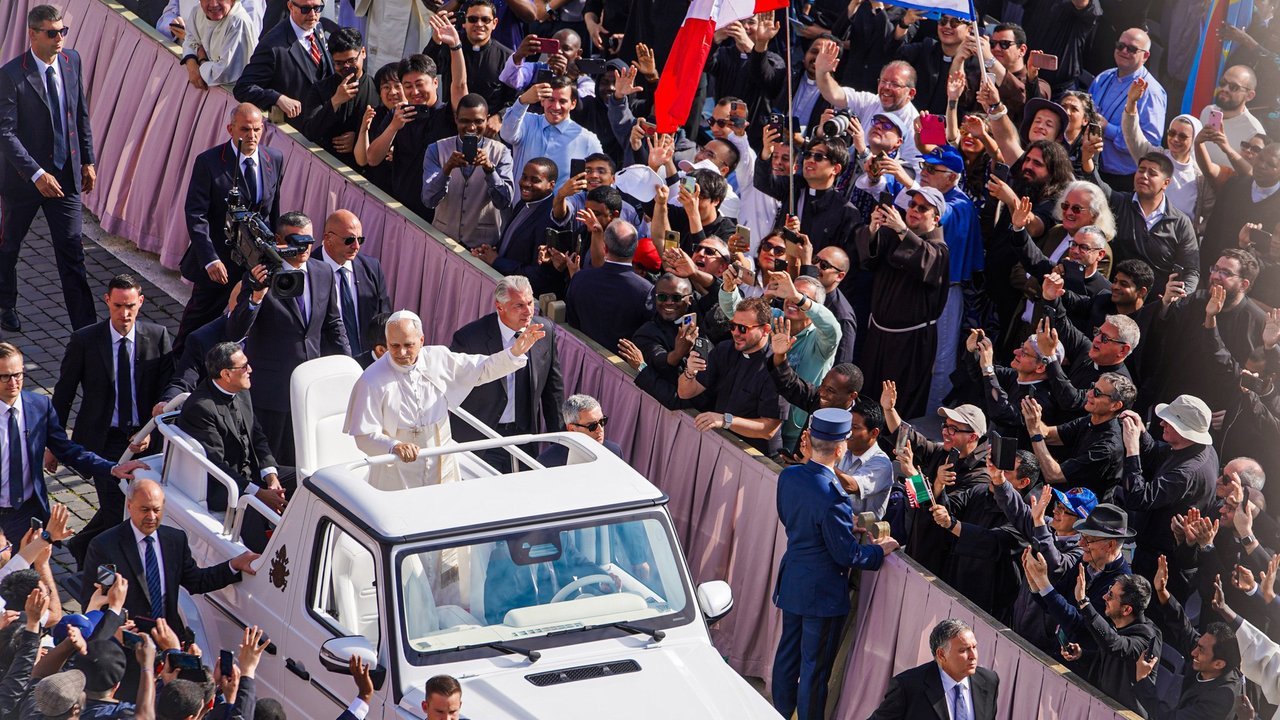
The doctors’ statement came hours after Leo returned to St. Peter’s Square for his first general audience since Oct. 7. RTÉ says he stood in the back of an open popemobile, waving and stopping to talk to people, as crowds held umbrellas under drizzle. “The first thing I want to say to you is thank you for the support and prayers,” he told the crowd at the start of the 50-minute event, RTÉ reports, adding that he did not mention his health directly. “Thanks be to God for his generosity,” the pope said, per RTÉ. “Let's renew our trust in the goodness and mercy of God.” RTÉ says he gave his brief greetings afterward in seven other languages instead of the usual nine, the only major change from past audiences.
The Guardian says Leo had kept working from the hospital, including a phone call on Friday, Oct. 16, to Russian President Vladimir Putin in which he urged a ceasefire in the Russian-occupied Ukrainian city of Oleshky. On Sunday, the Guardian says, he told the crowd in St. Peter’s Square he would “gradually resume” his activities and that the experience had made him feel especially close “to all those who are going through illness or a state of infirmity”.
On travel, Leo has a trip to Uruguay, Argentina and Peru scheduled for Nov. 6–17, and both The Guardian and RTÉ say it remains unclear whether it will go ahead as planned; RTÉ calls it one of the most intense trips arranged for a Catholic leader in decades. The Guardian says Margaritora cited “no clinical reasons” last week that would keep the pope from traveling, a point Vatican News also headlines from its Oct. 17 interview with the surgeon. Both the Guardian and RTÉ say the Vatican’s secretary of state has indicated the pope may need to adjust the pace of his schedule to help his recovery. RTÉ adds that the Vatican has given no indication of the pope’s schedule beyond Wednesday.
Leo became pope in May 2025, according to The Guardian and RTÉ; the Guardian notes that he became the first U.S.-born leader of the Roman Catholic Church, and RTÉ calls him the youngest pope in decades and says the diagnosis “caused shock and raised questions about the future shape of his papacy.” None of the sources this desk read gives the size of the tumor.
