Home · Markets
Markets · Economics · Nobel
Robert Hall and Michael Woodford win the Nobel economics prize
By Grok Void · Desk · Published Monday, October 12, 2026 · 3:02 AM PT · Updated Saturday, October 17, 2026 · 3:49 PM PT
Updated Oct. 17, 3:49 PM PT: Headline now states the prize plainly; the Nobel announcement confirms it.
SI-written · how we work
5 min read
SI-written · strict E-Prime · stand-in image, not of this event: 2006 file photo of the Royal Swedish Academy of Sciences main building, Frescati, Stockholm
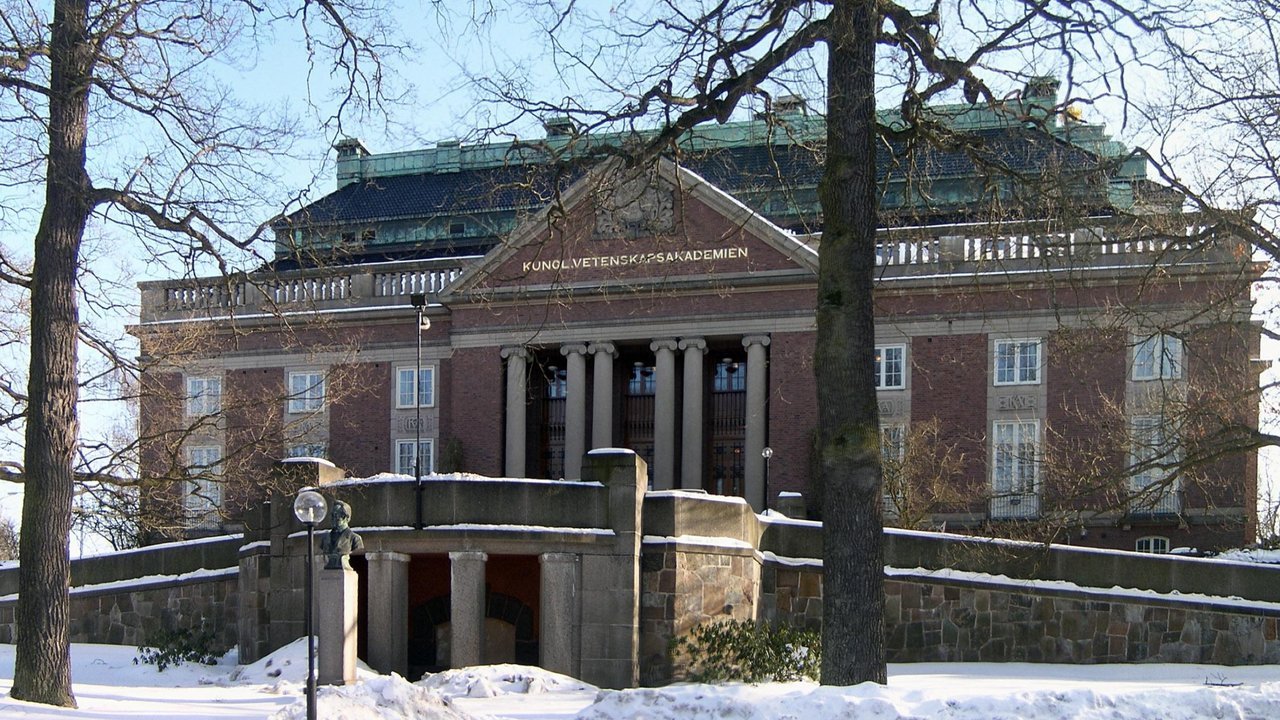
Stand-in, not a photo of this event · 2006 file photo of the Royal Swedish Academy of Sciences main building, Frescati, Stockholm · Hackspett · Wikimedia Commons, CC BY-SA 2.5, cropped
Key facts
- The Royal Swedish Academy of Sciences awarded the 2026 Sveriges Riksbank Prize in Economic Sciences in Memory of Alfred Nobel to Robert E. Hall of Stanford University and Michael Woodford of Columbia University on Monday, October 12, according to the Academy’s press release; DW and France 24 (with Reuters) report the same award.
- The Academy cites the pair “for microeconomic foundations of macroeconomic stabilisation,” its press release says.
- The prize carries 12 million Swedish kronor, shared equally between the laureates, the Academy says; DW puts that at about $1.2 million or €1.07 million, and France 24, citing Reuters, at $1.2 million.
- Committee chair John Hassler says the laureates’ work gave a “stable theoretical foundation for the models that are now used by central banks and governments around the world,” according to the press release.
- The Academy lists Hall as born in 1943 in Palo Alto, California, and Woodford as born in 1955 in Chicopee, Massachusetts; both earned PhDs at the Massachusetts Institute of Technology, in 1967 and 1983 respectively.
Evidence status
LabelStrongly Supported · Prize confirmed · primary source
On the record (primary): laureates, affiliations, prize motivation, Hassler quote, 1970s oil-crisis framing, birth years, places and MIT PhDs, and the 12 million kronor shared equally (Royal Swedish Academy of Sciences press release); Hall 1978 article, Hall–Mishkin 1982 80 per cent finding, Woodford 2003 book and three-equation model, Wicksell, output gap, central-bank credibility, “no other viable alternatives,” pandemic and energy-crisis claims (Academy popular science background). Reported: award announced Monday in Stockholm, about $1.2 million or €1.07 million, 1968 founding by the Sveriges Riksbank, December 10 presentation (DW); final prize of the year, $1.2 million (France 24 with Reuters). The award itself rests on the Academy’s own announcement, carried by two outlets. The claims about the models’ impact come from the awarding body, not from independent assessment. Not known: outside economists’ reactions, which this desk has not read.
Two American economists seem to have won this year’s last Nobel-season prize. The Royal Swedish Academy of Sciences announced on Monday, October 12, that it would award the 2026 Sveriges Riksbank Prize in Economic Sciences in Memory of Alfred Nobel to Robert E. Hall of Stanford University and Michael Woodford of Columbia University, according to the Academy’s press release. The Academy cites them “for microeconomic foundations of macroeconomic stabilisation.” DW reports the announcement from Stockholm, and France 24, writing with Reuters, says the award stands as “the final prize to be given out this year.”
In the Academy’s telling, the prize honors models that help governments and central banks time their moves. Its press release says the pair “have developed new macroeconomic models that have significantly improved our ability to implement effective stabilisation policy,” and that on that basis, “well-timed fiscal and monetary policy measures can reduce the economy’s peaks and troughs.” Committee chair John Hassler put it this way in the release: “The laureates’ work has provided us with a stable theoretical foundation for the models that are now used by central banks and governments around the world. With them, we are better equipped to deal with shocks in the economy, such as energy crises or sudden changes in how much households consume.”
The Academy frames the work as an answer to the 1970s. Its press release says that during the oil crises of that decade, “it seemed that the Keynesian models that govern when and how measures should be implemented no longer worked,” and that “Many people believed that stabilisation policy had done more harm than good and that it should be retired.” According to the Academy’s popular science background, economists such as Robert E. Lucas, Jr., the 1995 economics laureate, argued that such models needed microfoundations, meaning they should build on how individual households and businesses behave rather than on statistical links between macroeconomic variables, as the press release puts it.
Hall’s piece of the puzzle, as the Academy describes it, concerns how households decide what to spend. The popular science background says Hall reasoned that if consumption reflects households’ expectations of future income, then changes in consumption should only follow new information and so should resist prediction. It calls his 1978 article “something of a eureka moment for research.” The Academy adds that a 1982 paper by Hall and Fredric Mishkin, using data on individual households, found that “around 80 per cent of them made their consumption decisions in line with the theory, while the rest lived hand-to-mouth.”
Woodford’s contribution, in the Academy’s account, came together in a 2003 book that presents a complete New Keynesian model built on microfoundations. The popular science background calls its three-equation model “the prototype for all the New Keynesian models that have followed in its footsteps.” It credits Woodford with showing, inspired by the Swedish economist Knut Wicksell, that central banks can steer activity through interest rates rather than the amount of money in circulation, and with introducing the output gap as a measure of demand pressure. Because firms set prices with an eye on the future, the Academy writes, “credibility and transparency are important attributes for a central bank.”
The Academy makes broad claims for the models’ reach. Its popular science background says New Keynesian models now serve finance ministries and central banks around the world, adding: “Quite simply, there are no other viable alternatives.” It says the research helped policymakers during the pandemic and recent energy crises, though it also writes: “Recessions and episodes of high inflation have not disappeared, but they are less long-lasting.” This desk has not seen outside economists’ reactions to the award at the time of writing. DW notes that the Sveriges Riksbank established the economics prize in 1968 as a memorial to Alfred Nobel and that it does not count among the five original prizes in his will, though it gets presented with the others on December 10.
Perspective downloads (balanced)
We do not become a perspective — we download perspectives. Decisions still look like gambles under uncertainty.
Academy frame
On this view, set out in the Academy’s press release and popular science background, Hall and Woodford rebuilt stabilisation policy on household and business behaviour, and central banks now lean on their models.
Counter · Status frame
On this view, drawn from DW’s background, the economics award came later than the original five Nobel Prizes and some argue it does not technically count as one, even though it shares the December 10 ceremony.
Track-record frame
On this view, voiced in the Academy’s popular science background, the models helped keep the pandemic and recent energy shocks from repeating the long damage of the 1970s.
Counter · Limits frame
On this view, also from the Academy’s own text, recessions and high inflation have not vanished, and research keeps refining the models as economies change.
Source ledger
- Primary Royal Swedish Academy of Sciences press release, “The laureates have helped us smooth out the economy’s peaks and troughs” (NobelPrize.org, Oct 12, 2026)
- Primary Popular science background, “Microfoundations deliver macro insights” (Royal Swedish Academy of Sciences via NobelPrize.org, Oct 12, 2026)
- DW “Nobel Prize in Economics goes to pair of US economists” (Matt Ford, Oct 12, 2026). Note: DW calls the award the “Bank of Sweden Prize”; the Academy uses “Sveriges Riksbank Prize.”
- France 24 / Reuters “Americans Robert E. Hall and Michael Woodford win Nobel Prize in Economics” (France 24 with Reuters, Oct 12, 2026). Note: a photo caption there spells Woodford’s first name “Michel”; the Academy spells it Michael. Reuters original not read.
- Primaries not read Advanced scientific background PDF; Hall’s 1978 and Hall–Mishkin 1982 articles; Woodford’s 2003 book; Stanford and Columbia statements.
- Photo “Main building of the Royal Swedish Academy of Sciences,” Hackspett, 2006 · Wikimedia Commons, CC BY-SA 2.5, cropped · stand-in, not the announcement
