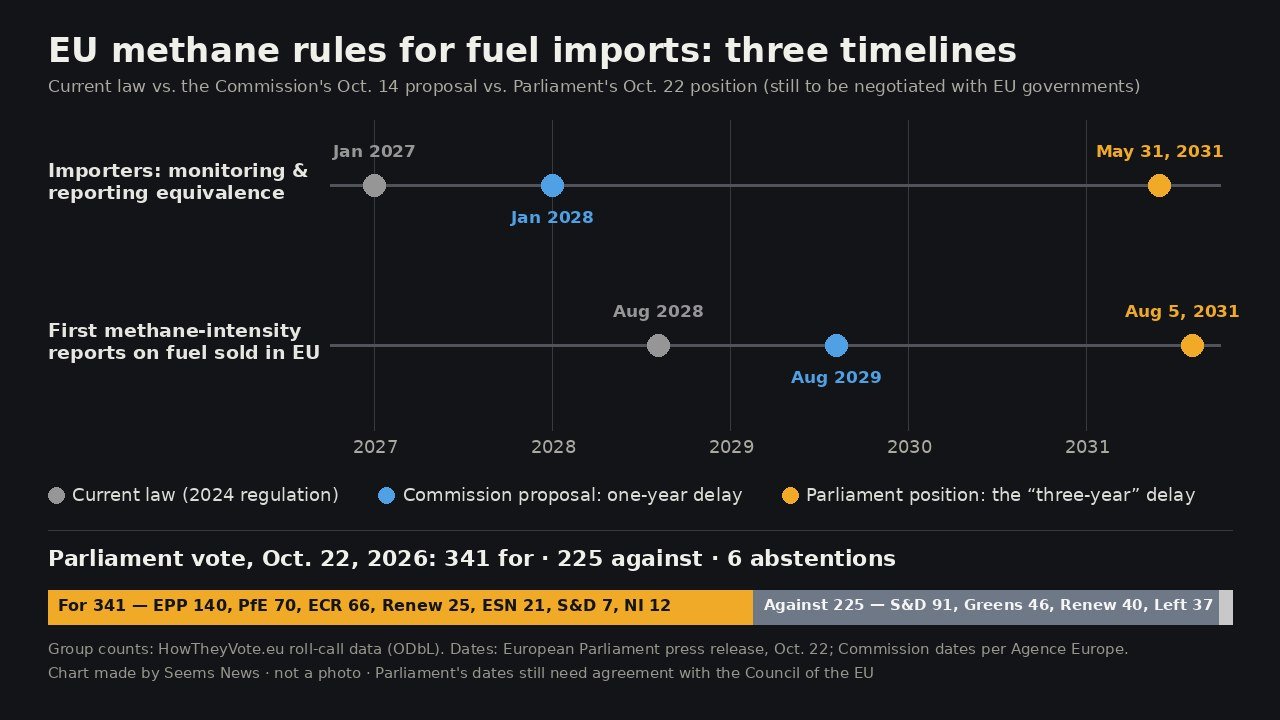
Europe’s first law to police methane leaks from the oil, gas and coal it buys abroad looks headed for a longer pause than its own authors wanted. On Thursday, Oct. 22, the European Parliament voted by 341 to 225, with 6 abstentions, to postpone key parts of the EU Methane Regulation by three years, “two more than proposed by the Commission,” according to the Parliament’s press release. The vote does not change the law yet. It fixes Parliament’s starting point for talks with EU governments, who have not settled their own view.
The regulation entered into force on Aug. 4, 2024, and the Parliament calls it “the world’s first comprehensive legislation that also regulates methane emissions related to imports of oil, gas and coal” (European Parliament). It requires companies that import fossil fuels to show that suppliers outside the bloc meet equivalent standards for monitoring, reporting and verifying methane, Euronews explains. Methane ranks as the second-largest contributor to climate change after carbon dioxide, Reuters notes.
The new dates come in layers. Under Parliament’s text, importers would have until May 31, 2031, “to show that supply contracts concluded or renewed since 4 August 2024 cover only fuel subject to monitoring, reporting and verification measures equivalent to EU rules,” the press release says; current law sets those importer obligations to start on Jan. 1, 2027. EU producers and importers would first report the methane intensity of the fuels they sell in the EU by Aug. 5, 2031, rather than Aug. 5, 2029. EU oil and gas operators would get three more years for verified reports that combine source-level and site-level measurements: February 2030 for assets they operate and August 2031 for assets they do not.
Brussels had asked for much less. The Commission announced its targeted amendment on Oct. 14, Agence Europe reports, proposing to postpone importer monitoring and reporting duties to January 2028 and methane-intensity reporting to August 2029, a one-year shift. Importers had warned they might not secure enough compliant supplies “at a time when energy markets are strained and prices high due to the conflict in the Middle East,” the Parliament writes. Reuters says that until a few weeks ago the EU appeared set for a one-year delay, before lobbying for three years intensified, including from the Czech Republic and Italy, and that France and the United States also pressed for more time (Reuters).
The longer delay came from the centre-right. The European People’s Party tabled the amendments, EUobserver reports, and pushed for the vote after political negotiations broke down on Wednesday, according to three parliamentary sources cited by Euronews. The EPP group spokesman on industry and energy, Christian Ehler, had called the Commission’s one-year delay “far from sufficient,” Euronews reports, and said the EPP and at least 15 EU countries had asked for three years. “This is not about increasing or permitting further methane emissions, it is about security of supply and lower energy prices,” Ehler said, per Euronews. Greek EPP lawmaker Dimitris Tsiodras said the result provides “greater legal certainty,” allowing verification systems to become fully operational (Euronews).
The roll call shows a chamber split largely along left-right lines. According to HowTheyVote.eu, which compiles the Parliament’s official roll-call records, the EPP voted 140 to 1 in favour, and Patriots for Europe (70), the European Conservatives and Reformists (66) and Europe of Sovereign Nations (21) voted in favour without a vote against. The Socialists and Democrats voted 91 against and 7 for, the Greens 46 against and the Left 37 against, while the liberal Renew group split 40 against and 25 for. Social Democrats and Liberals had backed the Commission’s one-year delay, while the Greens and the Left wanted the original timeline kept, Euronews reports.
Critics did not mince words. Jutta Paulus, a Greens/EFA lawmaker and the Parliament’s lead negotiator on the regulation, called the three-year push “an absolute scandal” and said conservatives and the far right “serve the interests of the fossil fuel industry,” according to Euronews. Flora Witkowski of Climate Action Network said the vote “only serves the interest of the fossil fuel industry, not people,” and put the cost at “an additional €185bn in damages.” The European Civil Society Observatory on Methane argued that “global supply shocks and Europe's dependence on fossil fuels” drive current market pressures, and estimates that applying the rules in full and on time could bring about €704 billion in benefits against €49 billion in regulatory costs (Euronews). This desk did not check those estimates.
Supporters framed it as realism. Parliament President Roberta Metsola wrote on X that the vote gave energy companies more time to prepare, calling it “a more realistic timeline,” and described it as “strengthening Europe’s energy security,” Euronews reports. Reuters adds that the United States, Europe’s biggest supplier of liquefied natural gas, had warned in June that the methane law could disrupt fuel deliveries, a stance backed by companies including ExxonMobil (Reuters).
Some guardrails survived. Lawmakers agreed that the extra time should not help fuel from countries the EU has sanctioned: oil, gas and coal originating in or exported from those countries would stay on the existing schedule, importers would report such volumes separately, including in mixed cargoes, and the Commission would publish an indicative list of the countries concerned (European Parliament). EUobserver says the sanctions amendment came from Dutch Socialist lawmaker Mohammed Chahim and in practice means Russia (EUobserver). Lawmakers also rejected a Patriots for Europe proposal to suspend the regulation altogether and an ECR push for even longer delays on some parts, EUobserver reports. The Commission would have to report by July 1, 2029, on penalties, verifier accreditation, the methane-intensity method and security of supply, and propose changes if problems persist (European Parliament).
What happens next depends on the member states. Parliament handled the file under its urgent procedure and wants the change to take effect the day after publication in the EU’s Official Journal (European Parliament); Euronews reports the aim of bringing the changes into force before the end of the year. But EU ambassadors could not reach a qualified majority on Oct. 21, Agence Europe reports: some governments, Germany among them according to several sources, wanted more time, while others called one year too short. The Irish Council presidency’s draft mandate would keep the Commission’s one-year text unchanged, the agency adds, and ambassadors plan to meet again on Oct. 28. Only after that can interinstitutional negotiations begin (Agence Europe).
This desk read the Parliament’s press release; Reuters (via a syndicated copy on y94.com); Euronews; EUobserver (free portion); two Agence Europe bulletins (free portions); and the roll-call breakdown on HowTheyVote.eu. It did not read the adopted text itself, Metsola’s post on X directly, or the Commission’s proposal. The chart above comes from those figures and shows dates, not emissions.