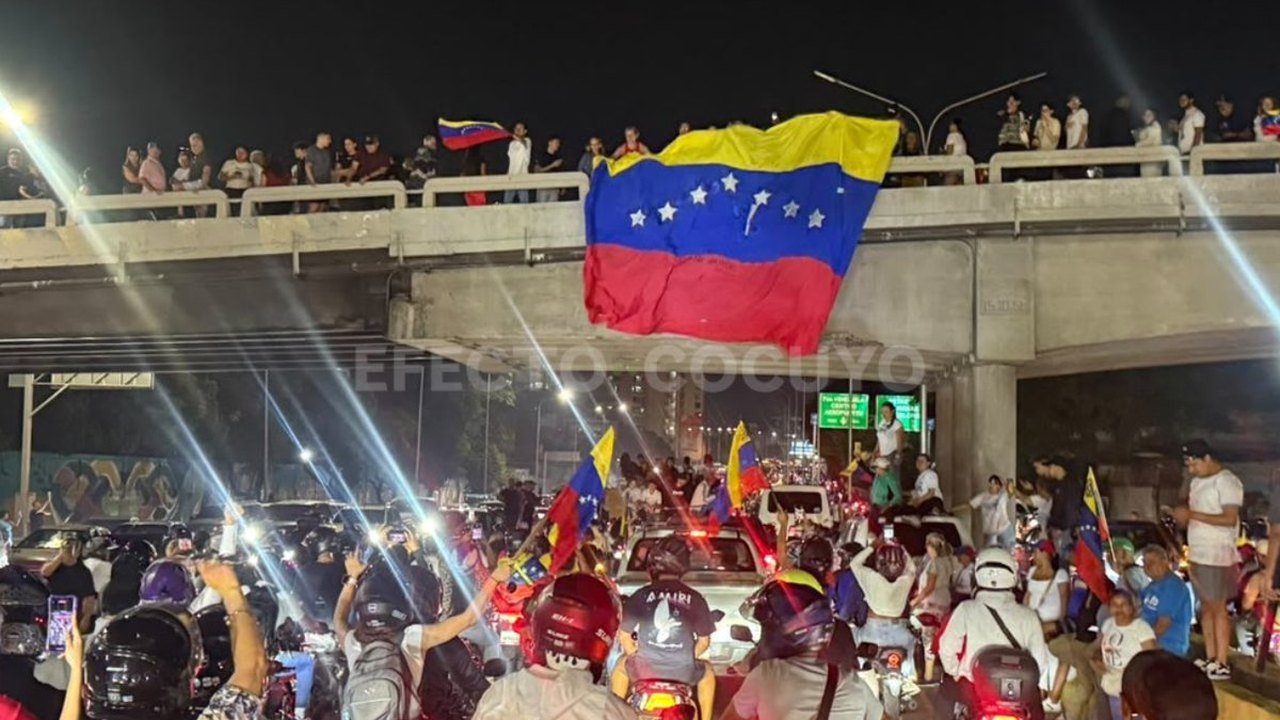
María Corina Machado, the Venezuelan opposition leader who won the 2025 Nobel Peace Prize, returned home on Sunday, Oct. 25, after more than 10 months in exile, according to the BBC (BBC). “I’m here. With you all,” she wrote on X, Reuters reports; the BBC renders the same Spanish post, “Estoy aquí. Con ustedes,” as “I am here. With you” (Reuters; BBC). BBC Mundo says she posted it shortly before noon local time, around 9 a.m. PT (BBC Mundo). By late evening she had reached Caracas at the head of a road caravan, and just before 10 p.m. local time (about 6:45 p.m. PT) she wrote “¡Finalmente, Caracas, estoy aquí!”, announcing her arrival in the capital over a video of supporters greeting her, BBC Mundo reports (BBC Mundo; her X post).
How she got in remained partly undisclosed. Her team gave no details, according to Reuters, but four people familiar with her movements told the agency that she travelled in a private plane from Panama to Colombia and crossed overland into Venezuela on Sunday (Reuters). One person briefed directly on her plans told Reuters that the flight took place late last week, that US security contractors guarded her during the journey, and that the United States warned interim President Delcy Rodríguez and Venezuelan authorities not to interfere with her or threaten her safety. The same person said the US, Panamanian and Colombian governments coordinated the return, and that Trump approved it and received updates (Reuters). The White House and the State Department did not respond to Reuters’ questions.
Trump, speaking to reporters at the White House on Sunday, offered a different account. “I don’t know anything about” her return, he said, according to the BBC, adding: “I think she’s a very nice woman. She gave me her Nobel Prize, so how can I say anything else? And I hope she’s safe” (BBC). Reuters quotes him as saying, “But we’re doing really well in Venezuela,” and reports that he suggested Washington would keep backing Rodríguez (Reuters). In January, Machado gave her Nobel medal to Trump at the White House; the Nobel committee had said the prize “cannot be revoked, shared, or transferred to others,” the BBC notes (BBC).
Secretary of State Marco Rubio tied the moment to diplomacy. “The conditions allowing for the safe return of Ms. Machado to Venezuela are the direct result of the US-supported reconciliation talks which have already seen hundreds of political prisoners freed and hundreds of political opposition figures return from exile,” he said in a statement, Reuters reports. “We expect all political actors to support these talks which represent the best chance Venezuela has had in thirty years to peacefully achieve not just a free and fair election but an enduring democracy” (Reuters). NPR quotes another line from him: “The United States expects the freedoms of all sectors of Venezuelan politics to continue to be respected” (NPR). Those talks, held this month between the interim government and one faction of the opposition, aim to remake the supreme court and the electoral council ahead of eventual elections, and have not included Machado’s movement, according to Reuters (Reuters).
The road home ran through the country’s center-west. NPR reports that she made her first public appearance among worshippers at the Church of Santa Rosa in Lara state, where an ecstatic congregation surrounded her (NPR). Her campaign, the Comando ConVzla, said she went there to give thanks for her return, according to CNN en Español; BBC Mundo and CNN also describe the stop as a visit to the sanctuary of the Divina Pastora in Barquisimeto, the Lara capital (CNN en Español; BBC Mundo). As she left in an SUV, bystanders sang the national anthem and shouted “liberty!”, a Reuters witness said (Reuters). Her team told CNN en Español that the caravan would stop at the Guacara toll plaza in Carabobo, the Palo Negro toll plaza near Maracay in Aragua, and the Valle-Coche highway in Caracas; earlier, supporters with flags met her in Chivacoa, in Yaracuy state (CNN en Español).
Crowds lined the highway. Thousands of people gathered along the route, many shouting “María, we love you,” “welcome” and “freedom,” Reuters reports (Reuters). “Maria Corina Machado will achieve liberty and democracy in Venezuela,” Hernan Adames, 69, told Reuters in Barquisimeto. Zuleima Granadillo, 61, an Education Ministry employee waiting in Aragua, told the agency: “This dictatorship is already over with the arrival of our leader.” In Caracas, hundreds of cheering supporters swarmed her car, NPR reports, and the BBC says photographs showed her smiling as she leaned out of a car’s sunroof (NPR; BBC).
Watch: from Barquisimeto to Caracas
Three video posts on X show Machado’s arrival at the church in Barquisimeto, a news report on her return and her own clip from Caracas. Two come from news outlets and one from Machado herself. This desk has not frame-checked the clips. If an embed does not load, it shows as a plain link.
View the @eldiario post on X
View the @dw_espanol post on X
View the @MariaCorinaYA post on X
Her allies framed the return as a turning point. David Smolansky, her spokesman, called it “a major step toward a democratic transition and free, fair, and verifiable presidential elections in the near future,” and thanked Trump, Rubio, the US government and Congress, the BBC reports (BBC). He told Reuters that she plans to meet victims of the deadly June earthquakes, families of political prisoners, members of the international community and other opposition leaders, and that “She will work proactively for a date for free and fair elections” (Reuters). Edmundo González, the 2024 opposition candidate who lives in exile in Spain, wrote that “Our sovereign voice returns with her to lead and guide this process” and said he would join her soon, NPR and the BBC report (NPR; BBC).
Figures inside the talks welcomed her too. Dinorah Figuera, who leads the opposition delegation in the dialogue with Rodríguez’s government, said in Spanish that she celebrated Machado’s return in freedom and called it a direct result of Jan. 3 — the day of Maduro’s capture, in BBC Mundo’s account — and of the strength of the dialogue, BBC Mundo reports (BBC Mundo). The opposition alliance known as the Plataforma Unitaria Democrática called Machado the “líder de las fuerzas democráticas” (leader of the democratic forces). In Washington, Deputy Secretary of State Christopher Landau wrote that he prayed “por la paz, la justicia y la reconciliación en Venezuela” (for peace, justice and reconciliation in Venezuela), CNN en Español reports (CNN en Español).
The context explains the caution. US forces seized President Nicolás Maduro in January; he remains in jail in New York, the BBC reports, and Rodríguez, his former deputy, took over as interim president with Trump’s backing (BBC). Trump said in September that the time had not yet come to consider democratic elections, US officials asked Machado at least once to delay her return, and she made several failed attempts to enter the country, Reuters reports (Reuters). An adviser said in September that she had tried seven times in a few weeks, according to the BBC, which notes reports of US involvement in the delays that Washington has denied (BBC). NPR reports that Washington says Venezuela must first stabilize before elections (NPR).
Her standing at home looks considerable on paper. She won an independent opposition primary in 2023 with more than 90% of the vote before Maduro’s government barred her from running, a decision she called politically motivated, according to the BBC (BBC). BBC Mundo writes that various polls put her support between 50% and 70% even while abroad, and that she will likely press to influence the naming of new supreme court and electoral council members (BBC Mundo). Her Vente Venezuela movement launched an app on Saturday to collect voter registration details from Venezuelans abroad, according to Reuters (Reuters).
What comes next remains open. The BBC writes that it stays unclear what Machado plans now, though she has said she would run for president again if an election took place (BBC). BBC Mundo adds that nobody yet knows how the top of the ruling chavista movement, which has long treated her as a radical enemy, will react (BBC Mundo). As of Reuters’ report, the Communications Ministry, which handles press queries for the government, had not responded to requests for comment (Reuters).
Correction · Oct 26, 2026, 1:05 AM PT: An earlier version of this story’s status label credited Reuters with a 9:45 p.m. arrival time in Caracas. That time came from the timestamp of Machado’s own X post (9:46 p.m. Caracas), not from Reuters; the label now says so. The desk also replaced an internal workflow note in the source list’s lead-photo entry with a plain description of the photo.