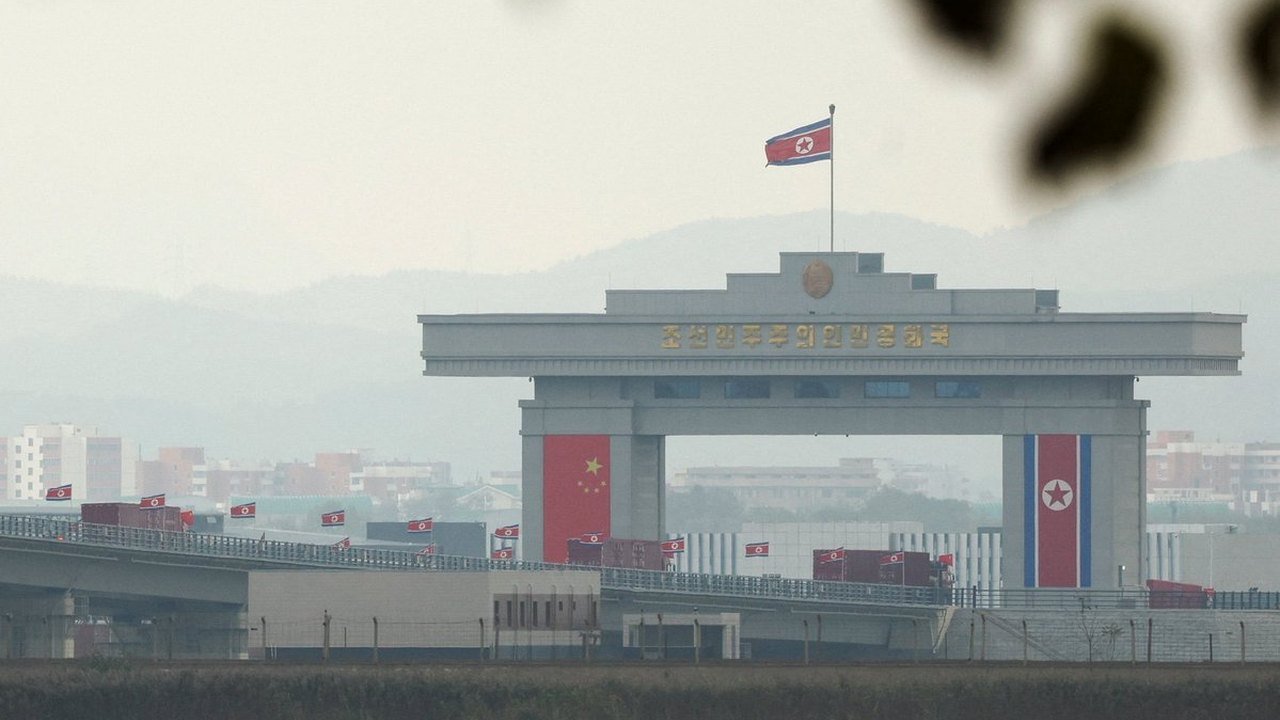
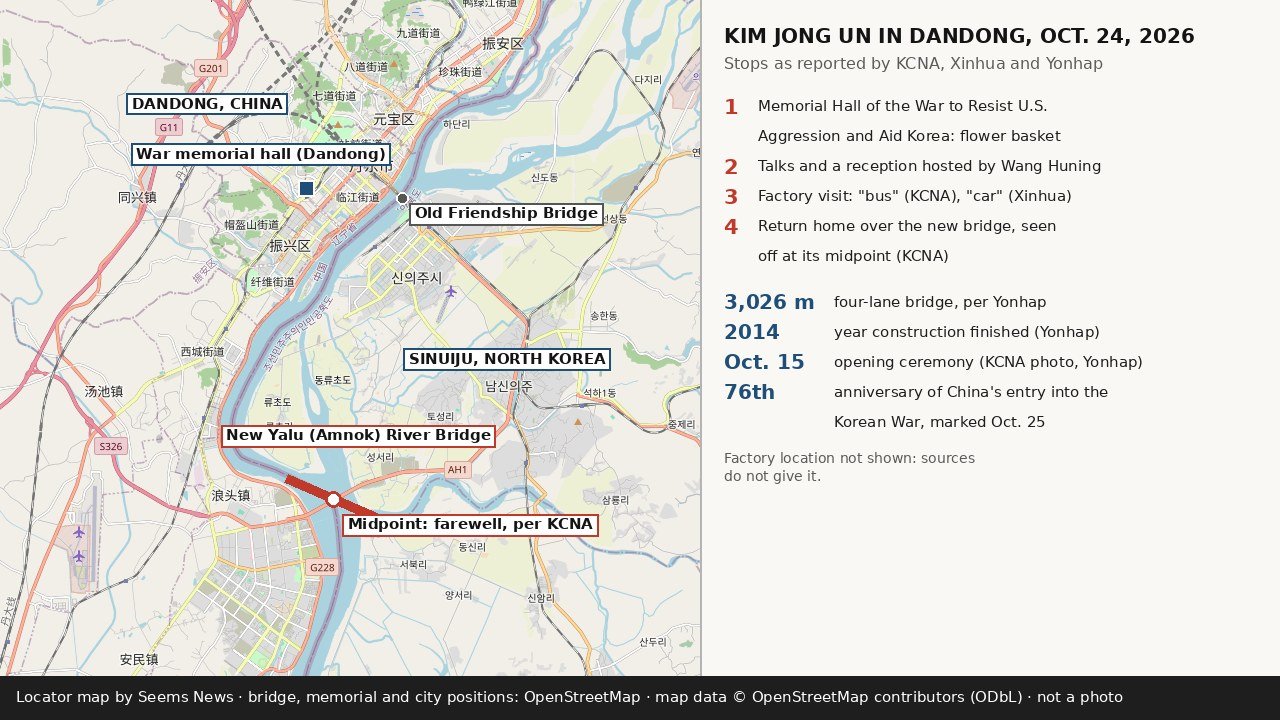
North Korean leader Kim Jong Un crossed into China on Saturday, Oct. 24, for a one-day visit to the border city of Dandong, where he honoured Chinese soldiers killed in the Korean War and met Wang Huning, whom Yonhap describes as China’s fourth-highest-ranking official (Yonhap), according to North Korean and Chinese state media. China’s Xinhua News Agency, in a dispatch datelined Dandong, says Wang greeted Kim on Saturday morning at the Memorial Hall of the War to Resist U.S. Aggression and Aid Korea and, when Kim left Dandong, saw him off at the new China-North Korea bridge over the Yalu River (Xinhua). North Korea’s Korean Central News Agency confirmed the trip on Sunday morning, Korean time, in a long report that ends with Kim crossing the new bridge home (KCNA; Yonhap).
Watch: Kim at the new bridge
Video posts on X from Reuters and Al Jazeera English, embedded from the outlets’ own accounts. If the embeds do not load, each shows as a plain link. This desk did not frame-check the footage.
View the @Reuters post on X
View the @AJEnglish post on X
The visit came a day before Oct. 25, which both governments mark as the anniversary of the Chinese People’s Volunteers’ entry into the 1950–53 war (Yonhap); this year marks the 76th (KCNA; Yonhap). KCNA lists a large delegation at Kim’s side, including Jo Yong Won, a member of the ruling Workers’ Party’s top Presidium, Foreign Minister Choe Son Hui and Kim’s sister Kim Yo Jong, a party department director (KCNA; Yonhap), as well as First Vice-Premier Kim Tok Hun (KCNA). On the Chinese side, KCNA names Foreign Minister Wang Yi, International Liaison Department head Liu Haixing, Liaoning provincial party secretary Xu Kunlin and Dandong party secretary Jiang Bing (KCNA).
At the memorial, honour guards laid a flower basket while the two national anthems played, Xinhua reports, and Kim arranged its ribbon (Xinhua). The two agencies render the ribbon differently in English: “The martyrs of the Chinese People’s Volunteers (CPV) are always remembered,” in Xinhua’s version, and “The fallen soldiers of the Chinese People’s Volunteers will be remembered forever,” in KCNA’s (Xinhua; KCNA). KCNA reports that Kim called the hall “a precious blood-stained verification of the invincible DPRK-China friendship” and presented a plaque bearing a photograph of his grandfather, North Korea’s founder Kim Il Sung (KCNA).
In talks afterward, KCNA quotes Kim as telling Wang: “We will always remember the history when the excellent sons and daughters of the Chinese people helped our revolution at the cost of their blood and steadily and firmly carry forward the history of the DPRK-China friendship” (KCNA; Yonhap). Reuters, in a report carried by The Straits Times, translates related lines differently, quoting Kim as saying North Koreans would “forever remember the glorious years of fighting alongside the Chinese people” (Reuters via The Straits Times). Xinhua’s account adds that Kim cited the 65th anniversary of the two countries’ 1961 Treaty of Friendship, Cooperation and Mutual Assistance and wished success to the upcoming fifth plenary session of the Chinese party’s 20th Central Committee (Xinhua).
Wang, according to Xinhua, called the trip “highly significant” and tied it to the bridge: its opening “can be taken as an opportunity to expand personnel exchanges and trade cooperation and better benefit the two peoples,” he said, and he called for “strengthening strategic communication and collaboration” (Xinhua). KCNA reports that Wang described the visit as significant for developing “the traditional China-DPRK friendship and militant fraternity” and hosted a reception for Kim “on the special instruction of Comrade Xi Jinping” (KCNA).
The accounts diverge on smaller points. KCNA says Kim toured the “Dandong City Bus Factory”; Xinhua says Wang took him to “a car factory in Dandong” in the afternoon; Yonhap and The Korea Herald call it an automobile factory (KCNA; Xinhua; Yonhap; The Korea Herald). On how Kim arrived, Yonhap reported on Saturday, citing South Korean government sources, that he reached Dandong over the New Amnok River Bridge, the Korean name for the New Yalu River Bridge (Yonhap). Yonhap’s later story on the KCNA report notes that it “did not specify whether he had used the bridge to enter China,” while The Korea Herald captions a KCNA photo as showing Kim crossing into China over the bridge (Yonhap; The Korea Herald). Reuters, in a report carried by The Korea Herald, writes that Kim “returned to his country by road on Sunday,” and an updated Reuters version on The Straits Times gives the date as “by road on Oct 25”; Xinhua’s Saturday dispatch and Yonhap’s “one-day visit” wording place his departure on Saturday, and KCNA’s text gives no time (Reuters via The Korea Herald; Reuters via The Straits Times; Xinhua; Yonhap; KCNA).
KCNA describes the farewell in detail. Wang and other officials walked Kim to the middle of the bridge, where, “enjoying a bird’s-eye view,” Kim said he expected the bridge to “undoubtedly and correctly fulfill its historic mission of linking the two countries and firmly joining the minds of the peoples of the two countries” (KCNA). The four-lane, 3,026-metre span, built with about $310 million in Chinese money, sat finished but unused from 2014 until an opening ceremony on Oct. 15, its debut delayed for years by North Korea’s failure to finish approach roads and customs facilities, according to Yonhap (Yonhap). This site covered the opening in an earlier story.
Yonhap places the trip within a broader warming. It calls the visit Kim’s first known trip to China since September 2025, when he traveled to Beijing to attend events marking the 80th anniversary of the end of World War II, and his sixth since he took power in 2011; Xi visited Pyongyang in June (Yonhap). Reuters describes the September 2025 trip as a visit for a military parade (Reuters via The Korea Herald). The agency also notes that China will host an Asia-Pacific Economic Cooperation summit next month that U.S. President Donald Trump will reportedly attend, and that Trump has expressed interest in talks with Kim, though “it remains unclear” whether this trip touched on regional security or diplomacy with Washington (Yonhap). Reuters describes the visit as part of “a sophisticated diplomatic balancing act” by Pyongyang, which has deepened military ties with Moscow over the past two years (Reuters via The Straits Times).
All of the official detail here comes from the two governments’ state media, which present the visit in celebratory terms; neither KCNA nor Xinhua mentions any agreements or new trade deals. This desk did not read an Associated Press report on the trip, which blocked automated access.
Correction · Oct 25, 2026, 1:08 AM PT: An earlier version of this story credited some details to outlets that do not carry them. It described Wang Huning as the fourth-ranked member of China’s Communist Party under a state-media attribution; that ranking comes from Yonhap. It credited the 76th-anniversary count to a Yonhap story that gives only the Oct. 25 date; KCNA and a later Yonhap story carry the count. It credited First Vice-Premier Kim Tok Hun’s presence to Yonhap as well as KCNA; only KCNA names him. And it credited a “Beijing parade” to Yonhap, which says Kim attended “events marking” the anniversary; the parade wording comes from Reuters. This desk now credits each detail to the outlet that carries it.