
Kenya has recorded a second death from Ebola. The health ministry announced on Friday evening, Oct. 23, that a 65-year-old woman receiving care for Bundibugyo Ebola had died, and it extended “heartfelt condolences to her family, friends and community” (Kenya MoH on X). The BBC, citing the ministry, reports that she belonged to the close family of Kenya’s first victim, a man who had travelled from DR Congo, and that she developed symptoms on Oct. 13 while already under quarantine (BBC). Nigeria’s Premium Times quotes the ministry: “Sadly, she succumbed to the disease early this evening,” and describes her as Kenya’s third confirmed case, with a safe and dignified burial planned in consultation with her family (Premium Times).
The ministry stresses containment. “Seven patients continue to receive care. All nine cases remain within one cluster, with no evidence of community spread,” its statement reads (Kenya MoH on X). According to the BBC, those still in treatment at two isolation facilities include three other relatives of the first victim, three health workers and a hospital cleaner (BBC). The WHO Africa office said on Saturday that it felt “deeply saddened” by the death and repeated that all nine confirmed cases “remain linked to a single cluster of known contacts, with no evidence of community transmission” (WHO Africa on X).
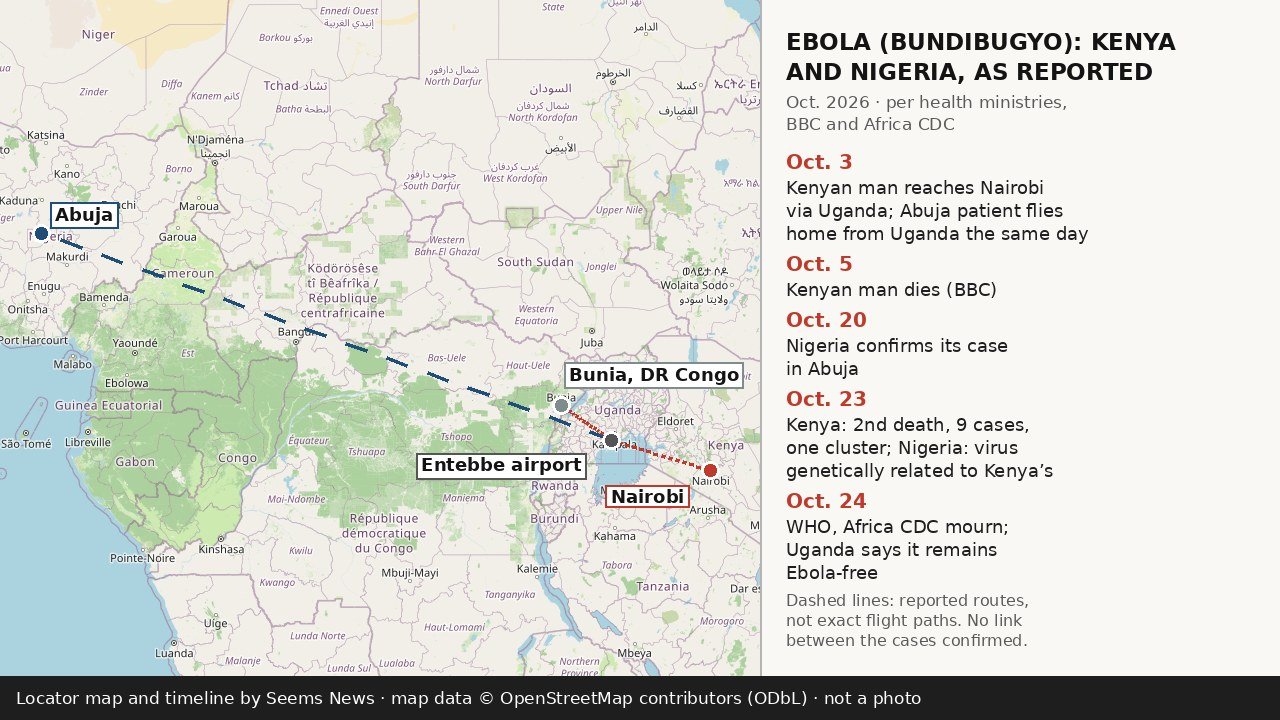
Hours before the death, Kenya’s eighth National Ebola Taskforce meeting, chaired by Principal Secretary Mary Muthoni, reported that teams had traced all 135 contacts linked to the initial case and that 14 samples tested from alerts across the country in the previous 24 hours had all come back negative (Kenya MoH on X). The ministry added that the first eligible contacts should complete their 21-day monitoring and return home from Sunday, Oct. 25 (Kenya MoH on X). Kenya’s first death came on Oct. 5, the BBC reports, after the man fell ill in September, received treatment in several hospitals in DR Congo and then reached Nairobi (BBC).
In Abuja, Nigeria’s Federal Ministry of Health reported that genomic analysis by the Nigeria Centre for Disease Control and Prevention and the Institute of Genomics and Global Health at Redeemer’s University, led by Professor Christian Happi, “indicates that the virus identified in Nigeria is genetically related to the virus identified in a case in Kenya” (Nigeria FMoH on X). Coordinating Minister Prof. Muhammad Ali Pate, the release says, emphasised that “further investigations are required to establish whether the two cases are epidemiologically linked” and that genetic relatedness “does not, in itself, establish a direct transmission link between cases.” The BBC adds that Pate said no evidence so far shows the Kenyan patient travelled to Nigeria (BBC).
The Nigerian patient, a 42-year-old Ugandan-born woman married to a Swiss diplomat, tested positive on Oct. 20 after returning to Abuja on Oct. 3 from about two and a half weeks in Uganda, the BBC reports; Switzerland’s foreign ministry confirmed her identity (BBC). Health officials now examine whether she crossed paths with Kenya’s first patient, who travelled from DR Congo through Uganda and reached Nairobi the same day. Dr Wessam Mankoula, Africa CDC’s head of emergency preparedness and response, called that “one of the possible scenarios” while stressing that investigators have established no link, and WHO emergency official Dr Patrick Otim said: “The source of exposure is still not known” (BBC). Africa CDC separately posted that Mankoula, speaking to TRT Afrika, pointed to “no validated information yet that Nigeria’s Ebola case travelled to DRC” (Africa CDC on X).
Related video posts from X
Each video below comes from the named X account. The desk read both posts through X’s API on October 24, 2026.
View the @thecableng post on X
View the @AfricaCDC post on X
Uganda has pushed back on any suggestion of local spread. Its health ministry wrote late Friday that it “wishes to assure the country that Uganda remains Ebola-free” and urged travellers to comply with screening at all points of entry (Uganda MoH on X). The BBC reports that the ministry announced on Friday that people who had travelled to DR Congo could no longer transit via Uganda, and that Uganda has held no confirmed active cases, having declared itself free of Ebola in August after two deaths in May (BBC Kenya report; BBC Nigeria report). Accounts of the Nigerian patient’s movements still conflict: the Swiss government told Reuters she did not travel to DR Congo, contradicting earlier Ugandan statements that she went to eastern DR Congo for business, per the BBC (BBC).
Governments along the routes have tightened checks. Nigeria’s health ministry issued a circular dated Oct. 22 ordering strict compliance with Ebola entry protocols at all points of entry, after the Office of the National Security Adviser raised concerns about reported non-compliance (Nigeria FMoH on X). Kenya now requires travellers from DR Congo and nine other countries, including Uganda, Tanzania and Rwanda, to fill in a digital surveillance form before boarding and show a QR code on arrival, the BBC reports (BBC). Kenya’s ministry asks anyone with symptoms or possible exposure to call the toll-free line 719 or use WhatsApp at 0700 719 719 (Premium Times).
The wider outbreak remains far larger. More than 4,000 people have died in Africa since Ebola gained confirmation in DR Congo in May, which the BBC calls the second most deadly outbreak of the disease; the International Rescue Committee counts more than 9,500 cases in DR Congo (BBC). A separate BBC report puts DR Congo’s toll at some 4,600 (BBC). The Bundibugyo species has no approved vaccine or treatment, the BBC notes (BBC). Africa CDC says the Tumaini trial has launched in Bunia, starting with an evaluation of Ervebo, with Bundibugyo-specific vaccine candidates expected to join later (Africa CDC on X).
This desk read the Kenyan, Nigerian and Ugandan health ministries’ posts on X, WHO Africa and Africa CDC posts, two BBC reports and Premium Times, as of about 10 a.m. PDT Saturday. An AP report did not load for this desk, so this story does not draw on it. The map above uses OpenStreetMap data and a timeline drawn from those sources; its dashed lines show reported routes, not exact flight paths, and do not imply a confirmed link between the two cases.