Japan’s space agency JAXA sent its Martian Moons eXploration (MMX) spacecraft toward Mars on an H3 rocket early on Tuesday, Oct. 20, Japan time, according to early reports. The rocket lifted off from the Yoshinobu Launch Complex on Tanegashima at 4:41 AM local time, or 12:41 PM PT on Monday, Oct. 19, Space.com reports, matching the 04:41:03 JST time in JAXA’s launch notice, which also listed a reserve window running from Oct. 21 to Nov. 9. The BBC, in an article by Rebecca Morelle, Alison Francis and Kevin Church updated at 12:45 PM PT, reports that a spacecraft “has launched from Japan headed for Mars’ moon Phobos.” Space.com posted its launch story at 12:53 PM PT.
Partner agencies cheered the liftoff. France’s space agency CNES posted “Lancement !” on X at 12:54 PM PT, tagging JAXA and Germany’s DLR. Space.com calls this flight the 10th liftoff of the two-stage H3 rocket, which it says JAXA and Mitsubishi Heavy Industries developed together, and describes the ascent as nominal: the four solid boosters dropped away in pairs just before two minutes into flight, the payload fairing came off about one minute and 20 seconds later, and the second stage took over near five minutes for a burn of about five and a half minutes.
The probe then left the rocket. Space.com, in an update posted at 2:00 PM PT, says the H3 upper stage relit about one hour and four minutes after liftoff for a trans-Mars injection burn of roughly six minutes and 25 seconds, and that MMX “was released from the rocket's upper stage right on schedule,” roughly 71 minutes after liftoff, as loud cheers rose in mission control on JAXA’s launch webcast. CBS News, in a story by William Harwood, says the 9,900-pound probe got “released to fly on its own” one hour and 11 minutes after liftoff, following two firings of the upper stage engine. This desk had seen no JAXA launch-result notice confirming the release when it published.
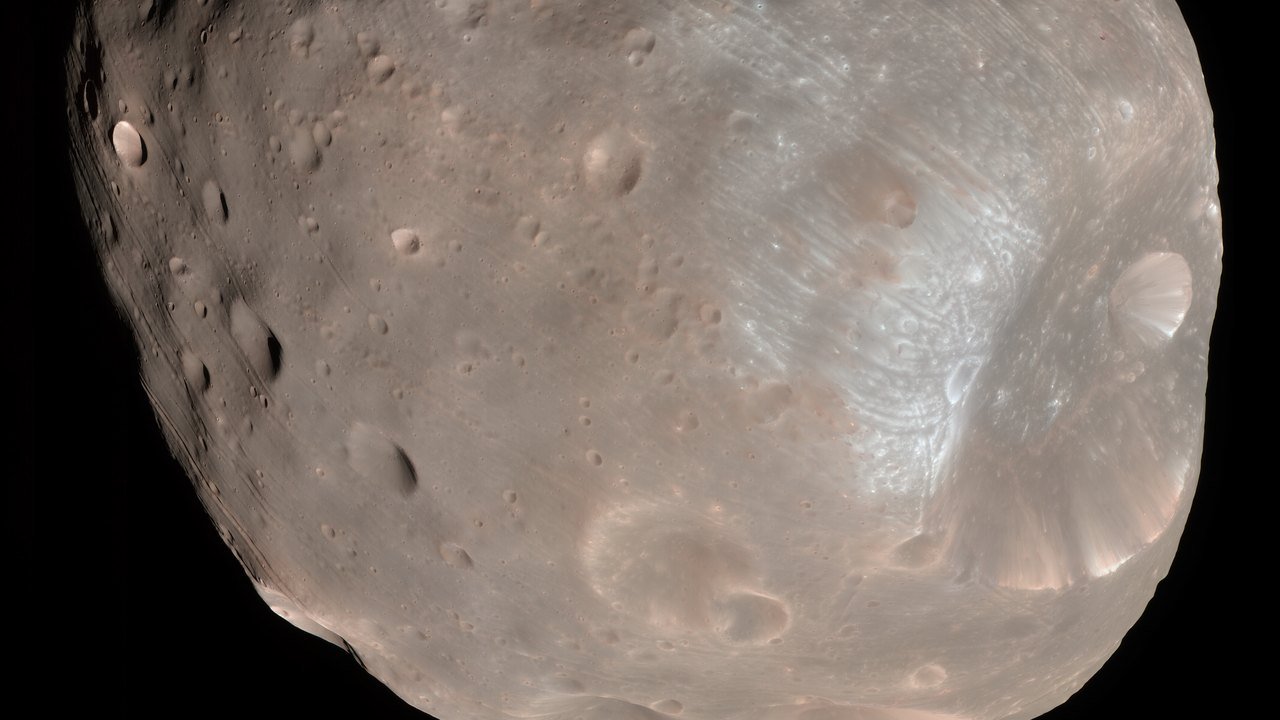
The mission targets Phobos, the larger of Mars’ two small moons. JAXA’s mission site says MMX will observe the topography, internal structure, composition and gravity of Phobos and return samples of its regolith, using thirteen scientific instruments, with a goal of more than 10g of returned material. JAXA describes the spacecraft as three modules — propulsion, exploration and return. Project manager Kawakatsu Yasuhiro writes on the site: “The Martian moon Phobos remains an unexplored frontier for humankind.”
Space.com lays out the planned route: about 10 months to Mars, arrival in August 2027, then an orbit that keeps MMX near Phobos as both circle Mars; CBS News instead says the spacecraft will brake into orbit around Mars in September 2027. It says the French-German IDEFIX rover should deploy to the surface in late 2028 or early 2029, that MMX itself plans two touchdowns to collect samples, and that it would study the smaller moon Deimos with flybys before leaving for Earth in November 2030. The BBC says the sample capsule would return in 2031 and land in the Woomera desert of South Australia, carrying about 10g.
Scientists on the mission frame the sample as a test of two ideas about where the moons came from. The BBC describes them as debris thrown up when a space rock hit early Mars, or two asteroids captured by Mars’ gravity, and quotes Prof Sara Russell of the Natural History Museum, the mission’s deputy for sample analysis: “When we get the sample back, we’ll be able to look in detail at its chemistry and its mineral composition - and the two hypotheses will produce very distinct results.” Russell also tells the BBC that grains blasted off Mars by impacts may have lodged in Phobos, so the sample “may actually contain grains of Mars as well.” NASA says its MEGANE gamma-ray and neutron instrument, built by the Johns Hopkins Applied Physics Laboratory with Lawrence Livermore National Laboratory, will help pin down the moon’s likely origin by reading its surface makeup.
Landing poses its own problem, Russell tells the BBC: “The moon itself doesn't have very much of its own gravity,” she said, “But it's next to an enormous planet that's got a much higher gravity, and that makes it much harder to get a rover onto the surface.” Dr Chrysa Avdellidou of the University of Leicester, who works with the mission, tells the BBC the 10g haul looks small but suffices: “You don't need to have kilos back from a surface in order to do science.”
The outlets size the moons differently. The BBC puts Phobos at about 20km (12 miles) across and Deimos at about 10km (six miles); Space.com calls Phobos 14 miles (22 km) wide and Deimos 8 miles (14 km) in diameter; 8 miles works out to about 13 km. CBS News gives a third figure, 17 miles across at its widest for Phobos. This desk did not check any of these figures against a JAXA or NASA fact sheet.
Space.com says NASA has invested about $87 million through the end of the mission, supplies the MEGANE spectrometer, a pneumatic sampler built by Honeybee Robotics and Deep Space Network support, and will receive at least 15% of the planned 10-gram sample for study at Johnson Space Center in Houston. It also notes that Russia’s Phobos-Grunt sample-return probe launched in November 2011 but never left Earth orbit. The BBC says the US Congress halted funding for the joint NASA-ESA Mars Sample Return mission, effectively cancelling it, and that China plans its own Mars sampling mission for 2028, aiming to return material in 2031.
