Gunmen opened fire on mourners at a funeral inside and around St George’s Greek Orthodox church in the village of Hamoud, in Jordan’s southern Karak governorate, on Friday afternoon, Oct. 23, and by Saturday the death toll had climbed to eight. Jordanian authorities called it an act of extremist terrorism, and the attackers remained at large on Saturday, Reuters reports via the Guardian and Al Jazeera (Guardian; Al Jazeera; Al Jazeera explainer). The Guardian calls it a rare attack on the country’s Christian minority (Guardian).
Video aired on the state-owned Al-Mamlaka television channel, apparently from a security camera on the church, showed three people firing at the building from a pavement while hiding behind trees and a low wall, then running toward its entrance, the Guardian reports; Reuters says it verified the video from the entry path, the wall around the church and other details (Guardian). Al Jazeera’s explainer adds that survivors heard an explosion just after the service began, that two attackers arrived in a vehicle and a third joined them with a semi-automatic rifle, and that the gunmen fired for several minutes (Al Jazeera).
“A solidarity gathering was held at the Greek Orthodox Church in Amman’s Sweifieh area on Friday to condemn the terrorist attack on a church in Hamoud village, Karak Governorate, reaffirming national unity and peaceful coexistence among Jordanians.” — AlMamlaka English (@almamlakaen) (October 23, 2026)
“The Greek Orthodox Church in the Christian town of Taybeh in the West Bank rang its bells at 9:00 p.m. today for the souls of the victims of the terrorist attack at St. George’s Church in Hamoud, Al-Karak, Jordan. The bells will ring again tomorrow at noon.” — Ihab Hassan (@IhabHassane) (October 24, 2026)
Survivors described close-range shooting. Nasser al-Burqan, a lawyer, told Reuters that one attacker, standing about two metres away, pointed a handgun at him and fired; his son, also at the service, later called to say he had a gunshot wound to the leg. “When everything finally quietened down, I looked out the window behind me, and I saw two [assailants] — one was masked, the other was not; he was carrying a handgun,” al-Burqan said (Al Jazeera). Ihab Ammareen told Al-Mamlaka he saw bloodied people collapse on the floor: “People were crying, wailing, screaming – it’s hard to describe” (Guardian). At a hospital, Tarek Ammarin, whose relative suffered injuries, called it “A massacre, a massacre in every sense of the word” (Al-Monitor/Reuters).
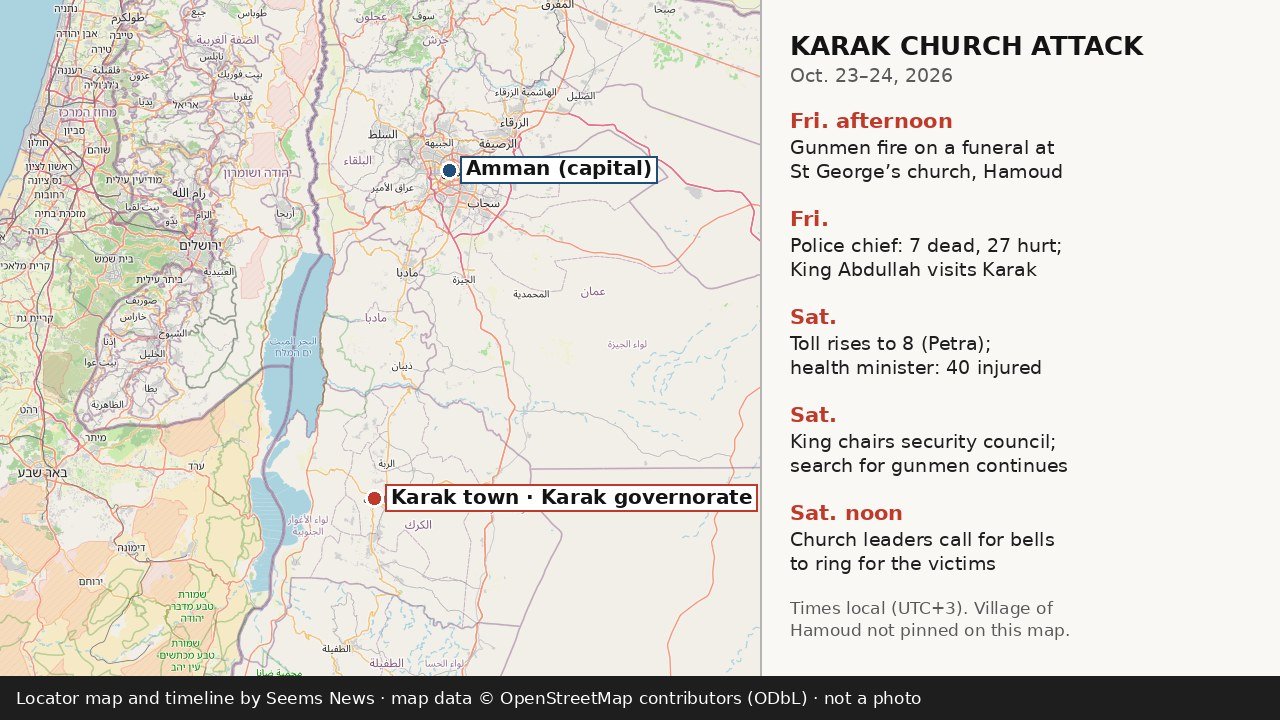
The count of the dead and wounded has shifted as the hours pass. At a Friday press conference in Karak, Public Security Director Maj. Gen. Obaidallah Maaytah put the toll at seven dead and 27 injured, according to the Jordanian site Roya News and Anadolu (Roya News; Anadolu). Xinhua, citing the Public Security Directorate on Friday, reported 34 injured (Xinhua). On Saturday, Petra reported that the director of Prince Ali Military Hospital in Karak announced the death of one of two critically injured patients, both of whom had undergone major surgery and needed artificial respiration, which brought the toll to eight (Petra). Health Minister Ibrahim al-Badour said one injured person remains in critical condition, Anadolu reports, citing Al-Mamlaka (Anadolu). The Guardian, carrying Reuters, cites the health minister for 40 injured; Al Jazeera says 27 of them remain in hospital (Guardian; Al Jazeera). This desk could not reconcile the injury figures, which may reflect different counting times or hospitals.
Officials have named no suspects. Government statements refer to “unknown assailants,” Al Jazeera reports, and Interior Minister Mazin Al Farrayeh said “extremists” carried out the attack while adding that it remains too early to tell whether they have links to known groups inside or outside Jordan (Al Jazeera; Guardian). No group has claimed responsibility (Guardian). Prime Minister Jafar Hassan wrote on X: “This is a result of a terrorist ideology and blind extremism and we will not allow society to go down this path” (Guardian). An Al-Mamlaka correspondent in Karak said on Saturday, as Roya News reports, that the Public Security Directorate had issued no official word of any capture of the attackers, that the pursuit continues, and that dozens of security checkpoints still operate across the governorate (Roya News).
King Abdullah visited Karak hours after the attack and said the perpetrators would face punishment “with an iron fist” (Guardian). In a statement he said: “The terrorist attack against Karak will be met with the harshest retaliation. Those who delude themselves into thinking they can divide Jordanians with their bullets have no chance in the face of our unity” (Guardian). On Saturday he chaired a National Security Council meeting with Crown Prince Al Hussein in attendance, received a briefing on the investigation, and directed authorities to respond with “an iron fist” against the khawarej — a term the statement glosses as the outlaws of Islam — and against anyone who supports or justifies the attack, according to Petra and Ammon News (Petra; Ammon News). He also ordered a comprehensive security assessment of the response, urged keeping the public updated on the investigation, and told the government to review policies for countering extremist ideology and draw up a plan with religious authorities (Ammon News).
Security tightened across the country. The US embassy in Amman says security agencies have cordoned off the area in Karak and continue the hunt, and that “There is also increased security at malls and other locations including foreign embassies in Amman” (US Embassy Amman). Prime Minister Hassan declared three days of national mourning starting Friday, with flags at half-staff on government buildings, Anadolu reports (Anadolu). Patriarchs and heads of churches in Jerusalem called on churches across the region to ring their bells at noon on Saturday, Petra reports (Petra). UN Secretary-General António Guterres condemned the violence, and US ambassador to the UN Mike Waltz called it a “depraved and brutal attack on a house of worship,” according to the Guardian (Guardian).
Local religious leaders and residents spoke out. The mufti of Karak, Walid Thunaibat, said the attack “runs contrary to the teachings of Islamic Sharia,” and Fr. Alaa Bair, Karak’s parish priest, called it an assault on the sanctity of life, Petra reports (Petra). Outside a hospital, Hani Al-Mbaydeen said, according to the Guardian: “But our only reproach to the state is that it must investigate these dark ideas – where they come from and how they enter the minds of our children” (Guardian). Karak has seen deadly violence before: in 2016, ISIL (ISIS) carried out a series of attacks there, including a siege at a Crusader-era castle that killed 10 people, Al Jazeera recalls (Al Jazeera).
Christians make up about 300,000 of Jordan’s 11.5 million people, and Karak governorate holds many of them, according to Al Jazeera (Al Jazeera). Reuters places the church about 120 km (75 miles) southwest of Amman (Al-Monitor/Reuters). Accounts differ on where the shooting started: the Al-Mamlaka video described by the Guardian shows gunfire from outside, while Al Jazeera’s explainer and Xinhua describe shooting inside the church (Guardian; Al Jazeera; Xinhua). Spellings of the village also vary — Hamoud, Hmoud and Hammoud — across Reuters, Petra and the US embassy alert.
This desk read reports from the Guardian and Al-Monitor (both carrying Reuters), two Al Jazeera pieces, Jordan’s state news agency Petra, Ammon News, Roya News, Anadolu and Xinhua, plus the US embassy’s security alert, as of about 7 a.m. PDT Saturday. An AP report did not load for this desk, so this story does not draw on it. The map above shows OpenStreetMap data and a timeline drawn from those reports; it contains no photo and does not pin the village of Hamoud.