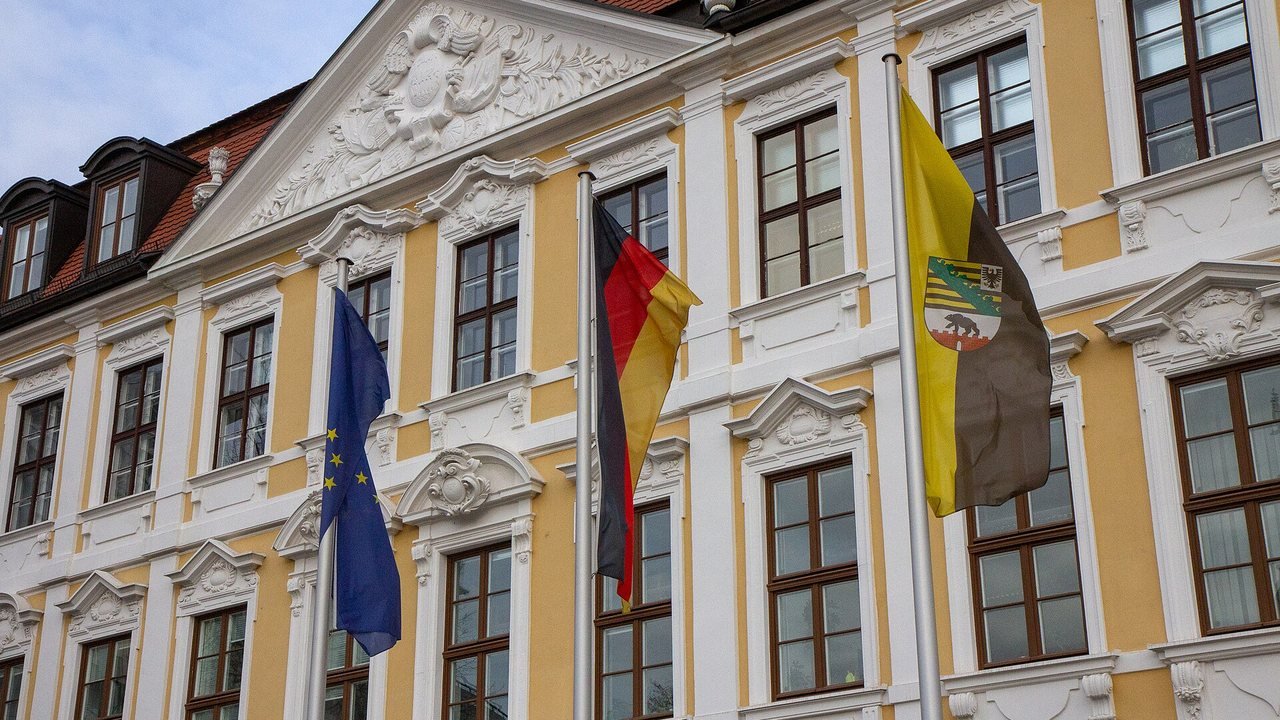
For the first time, a German state parliament has handed its top office to the Alternative for Germany. Saxony-Anhalt’s new legislature, meeting for the first time in the state capital of Magdeburg on Tuesday, October 6, elected the AfD’s Tobias Rausch as its president at about 12:40 p.m. local time (3:40 a.m. PT). The Guardian and DW describe him as the first far-right speaker of a German regional parliament since the end of World War II. Formally, the president of a state parliament holds the highest-ranking office in a German state, ahead even of the premier, though the role mostly involves running sessions, enforcing rules, and representing the chamber.
The numbers drew as much attention as the man. In a secret paper ballot, Rausch won 48 of 82 votes cast in the first round, with 29 against and five abstentions, according to MDR, the regional public broadcaster, and tagesschau. The AfD holds 39 seats after winning nearly 44% of the vote in the September 6 state election, and the BSW, a small left-populist party founded by Sahra Wagenknecht, had announced that its five members would vote for him. That adds up to 44. The four extra votes came from somewhere else. The SPD, the Greens, and the Left Party had all announced no votes, and the CDU’s parliamentary leadership had told its members to abstain.
The question of those four votes quickly reached Berlin. Heidi Reichinnek, who leads the Left Party in the Bundestag and grew up in Saxony-Anhalt, told reporters she felt sure the votes and the five abstentions came from the CDU. “Whoever gives their vote to a right-wing extremist has lost every right to call themselves a democrat,” she said, according to tagesschau (desk translation from German). Thorsten Frei, a senior CDU figure in the Bundestag, called that “pure speculation,” pointed out that the ballot stayed secret, and still called the outcome “highly concerning and worrying.” Matthias Miersch, who leads the SPD in the Bundestag and governs nationally alongside the CDU, called Rausch’s election “more than concerning” and said the coalition would raise the CDU members’ apparent break with their own leadership at a coalition committee meeting on Wednesday. Sandra Hietel-Heuer, a deputy parliamentary manager for the CDU in Magdeburg, told MDR she had not expected 48 votes for the AfD candidate and that she herself did not vote for him.
Rausch, a 35-year-old real estate agent who until Tuesday managed the AfD group’s parliamentary business, used his first speech to promise neutrality. “I will not serve in this office as the speaker of a single parliamentary group, but as the speaker of all parliamentary groups,” he said, according to DW. “Rules must apply even when the majority changes.” The Guardian reports he also promised to “take different opinions seriously and to try to take decisions in a transparent way.” MDR reports that he also said the time for political firewalls should end, a reference to the long-standing agreement among Germany’s other parties to shut the AfD out of power. Earlier this year his name surfaced in a nepotism scandal over AfD lawmakers hiring relatives and friends; the Guardian reports that he denied claims that several siblings and a brother-in-law worked in the parliament but confirmed hiring several players from his soccer club, and DW reports the same admission about his legislative office.
The day carried heavy symbolism. About 500 demonstrators gathered on Cathedral Square across from the parliament building in the morning, DW reports, with banners reading “No cooperation with the far right.” Eva von Angern of the Left Party, the chamber’s longest-serving member, opened the session as acting president. Before the vote, according to the Guardian, she drew a parallel with Hermann Göring’s use of the Reichstag presidency in the 1930s to smooth Adolf Hitler’s path to power. After Rausch won, SPD group leader Katja Pähle handed him a copy of Germany’s Basic Law and a white rose, a symbol of resistance to Nazism, and pointed MDR to Article 37a of the state constitution, which bars spreading Nazi ideology. Green group leader Susan Sziborra-Seidlitz told the chamber: “Whoever has invested a representative of extremist and anti-constitutional party with this office will bear responsibility for the consequences.” DW also noted that the AfD group, 37 men and two women, had won a seating plan that puts it in the middle of the chamber and pushes the other parties to the edges.
A second contested vote followed. The parliament elected the AfD’s Hans-Thomas Tillschneider, the party’s deputy state and group leader and the main author of its government program, as a vice president with 44 votes to 38, tagesschau reports. That gave him five votes beyond the AfD’s own 39. “Our five members definitely did not vote for Mr. Tillschneider,” BSW group leader Thomas Schulze told the German Press Agency, and CDU group leader Sven Schulze told MDR that his group had agreed “that we all vote against Mr. Tillschneider, and we did that today too.” The Guardian reports that Tillschneider has called Russian President Vladimir Putin “a real man with a sound set of values” and has described Islam as a “fungus” on the “German oak”; he told reporters he would carry out the office “entirely professionally and inconspicuously” and said he did not understand the concerns about him. The CDU’s Carsten Borchert then won a second vice-president seat with 64 votes, while the SPD’s Armin Willingmann lost 33 to 48, leaving the third seat empty for now.
The vote matters most for what may come next. The AfD came three seats short of a majority of its own. The BSW says it will support an AfD-led government only under a nonpartisan premier, a condition the AfD rejects, and DW reports the BSW will not vote for Siegmund. Siegmund still plans to stand for premier in a secret ballot in December and says he wants to win in the first round; if he fails, he has said he would push for fresh elections. On RTL before Tuesday’s session, Rausch put it plainly: “If we don’t have a majority in the first round of voting, we won’t have a majority for the rest of the legislative term either — in that case, it means the parliament doesn’t want us to govern,” as translated by DW.
The national leadership of the AfD celebrated. Party co-leaders Alice Weidel and Tino Chrupalla said years of exclusion had finally ended, tagesschau reports, and Weidel said: “In a democracy, people have to talk to each other. You cannot hide behind an undemocratic firewall” (desk translation). Wagenknecht had called it a matter of course that the largest group would name the president, and her deputy Christian Leye told German media: “We need an intelligent way of dealing with the AfD and that means dealing with the content of their programme instead of a firewall.” Green Bundestag leader Britta Haßelmann called it “a depressing day for democracy.”
The result adds pressure on Chancellor Friedrich Merz, who promised in 2025 to halve the AfD’s support. The Guardian notes that the AfD now polls around 30% nationally. As of late morning PT on Tuesday, no lawmaker had publicly admitted to supplying the four extra votes, and the CDU in Magdeburg had named no one.
