A suspected drone seems to have exploded over northern Lithuania on Sunday morning, Oct. 18, after an alert that, Reuters reports, forced residents in northern and central areas to seek shelter for an hour. Reuters, in a report by Andrius Sytas, says the president and other defence officials described the explosion, and that Ukraine’s foreign ministry later said it regretted the incident and that Russian electronic warfare may have diverted drones off course. The alert came the same morning as a Ukrainian drone strike on Russia: the Guardian reports that one person died and 15 got wounded overnight as Ukraine used more than 1,000 drones to target Russian oil depots, logistics facilities and datacentres.
President Gitanas Nausėda framed the incident in a post on X at 11:40 AM Vilnius time (1:40 AM PT): “Russia’s war of aggression against Ukraine is spilling over onto the Eastern flank of NATO and EU.” He wrote that NATO fighter jets stationed at Šiauliai Air Base scrambled “once again” after an unidentified object entered Lithuanian airspace, and added: “What appears to be a drone exploded over the northern part of the country, posing a danger to the civilian population. Our specialists are currently working at the site.”
During the “red” alert, NATO fighter jets scrambled and Kaunas airport, near Lithuania’s second-largest city, closed for a time, the Lithuanian government’s crisis management centre said, according to Reuters. The Lithuanian news agency BNS reports that flights to and from Kaunas stopped for about an hour and resumed at 7:49 AM local time, that flights at Šiauliai airport resumed at 8:02 AM, and that two flights from Kaunas, to Copenhagen and to Bari, ran late, citing Lithuanian Airports (desk translation from Lithuanian). The Guardian also reports the shelter call, the scramble and the airport closure, citing the national crisis management centre.
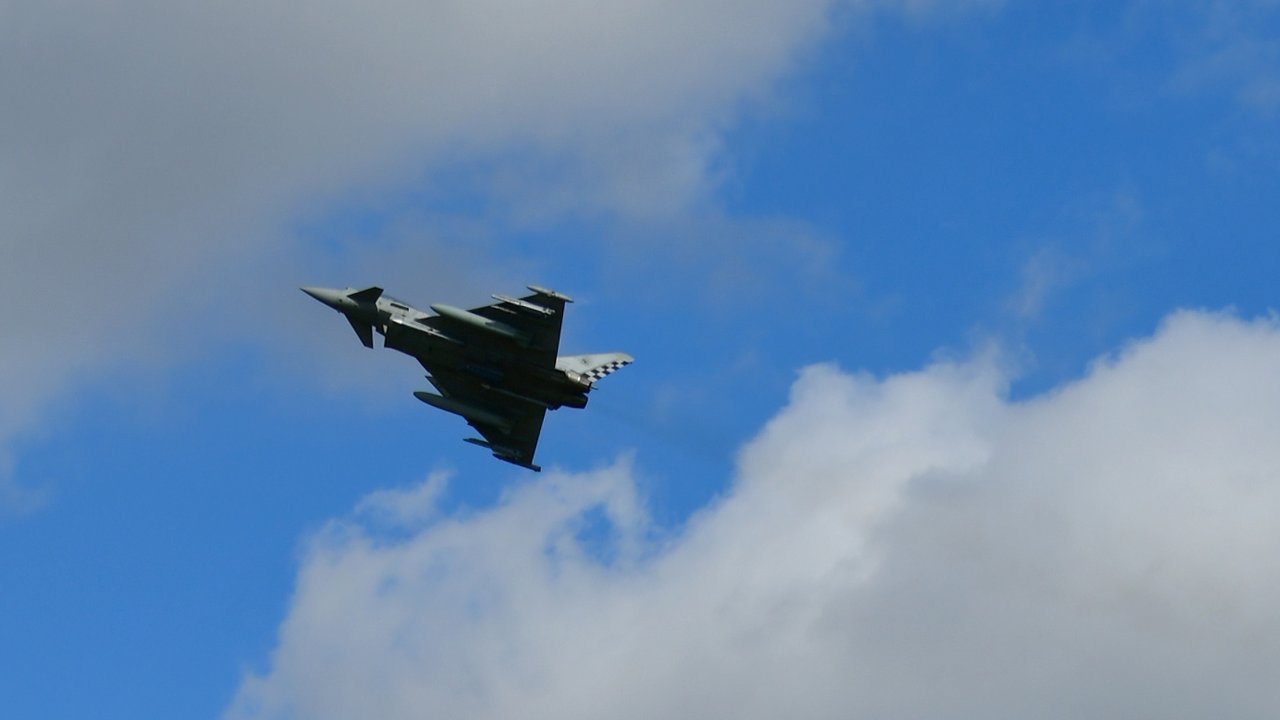
A NATO official told Reuters: “We can confirm that two Italian Eurofighter jets were scrambled earlier today in response to a drone over Lithuanian airspace.” The official added: “The aircraft were operating under NATO command. An investigation is ongoing, and NATO remains in close contact with the Lithuanian authorities.” Reuters, citing the crisis centre, says the NATO aircraft could not visually identify the object because of cloudy weather and did not try to shoot it down. Euronews quotes a social media post by Defence Minister Robertas Kaunas: “Due to difficult weather conditions, the fighter jet pilots are currently unable to visually identify the object.”
Kaunas said some of the debris struck a civilian vehicle, Reuters reports. LRT says the authorities later confirmed that drone debris hit and damaged a moving car and that no one got hurt, and it quotes Prime Minister Mindaugas Sinkevičius: “A person travelling from Biržai towards Pasvalys heard an explosion. Debris damaged their private car, denting the door.” LSM carries a slightly different English rendering of the same remark. Reuters, citing the crisis centre, says army personnel investigated possible drone debris near Juodzionys village after the object disappeared from radar; the ThePrint copy of the same Reuters story adds “possibly after exploding,” a phrase missing from the Straits Times copy.
Sources differ on the drone’s route into Lithuania. Kaunas told reporters, according to LRT: “The object is preliminarily believed to have entered Lithuanian airspace from Poland. I have already contacted the Polish defence minister and asked Poland to join the investigation so that we can look into this incident together.” Reuters reports the same claim of entry from Poland and the proposal of a joint investigation, but it adds that a Polish Defence Ministry spokesperson later said radar systems did not confirm the object crossing the border into Lithuania, while Polish authorities stayed in contact with Lithuanian officials. LSM reports that Polish authorities also investigated a possible airspace violation and that a search got under way south of Lublin for a spot where an unidentified object may have crashed. This desk found no Polish primary statement.
Ukraine’s foreign ministry spokesperson, Heorhii Tykhyi, wrote in a post on X at 12:52 UTC (5:52 AM PT): “We regret the incident that occurred this morning in Lithuanian airspace, which may have resulted from Russian electronic warfare diverting drones during an operation against legitimate military targets in Russia.” He added: “We apologise for any disruption, risks, and concern this may have caused.” The post’s edit history on X shows an earlier version, posted about seven minutes earlier, that named Lithuanian and Latvian airspace; Reuters also notes that the prior version mentioned Latvia. LRT reports that National Crisis Management Centre head Vilmantas Vitkauskas confirmed to LRT Radio that the object “was most likely a Ukrainian drone, which could have entered the country as Kyiv carried out strikes in the St Petersburg region.”
In a later interview, Kaunas gave more detail. In an LRT report citing BNS, posted at 19:52 local time, he told LRT television that this particular drone came from the attack on St Petersburg, that some drones strayed into Lithuanian territory because of Russian electronic warfare, and that preliminary information points to a Ukrainian drone of the FPV-1 model; he also said he would not link it to a separate attempt to set fire to premises in Vilnius where SpaceX operates (desk translation from Lithuanian). This desk could not verify the drone model, and Ukraine’s statement speaks only of a possible diversion.
LRT reports that an air alert went out only in northern Lithuania and that Kaunas called the situation “strange and unacceptable,” adding: “If the object had already been detected in one part of Lithuania, everyone should have been informed in time.” A Lithuanian-language LRT television report says that, if the drone entered from Poland, it would have had to cross Marijampolė county, where people received no warnings; it quotes Prime Minister Sinkevičius saying the warning system worked, but not fully, and a Pasvalys municipal official saying shelters stayed closed because no one asked for them to open (desk translation from Lithuanian).
In Latvia, the National Armed Forces issued a warning for the Bauska, Aizkraukle and Ogre municipalities at 07:40 and withdrew it at 08:12, LSM reports; the armed forces’ own notice says the threat ended at 8:12. LSM quotes the force: “there is a possibility that the unidentified object detonated itself. The incident site is located in the Pasvalys district, in northern Lithuania, near the Latvian border.” Euronews renders the Latvian military’s statement differently, saying the jets “did not shoot down the suspected unmanned aerial vehicle” and that it may have “detonated on its own.” Reuters calls the Latvian alert a “yellow” air warning citing a “possible threat.”
Ukrainian drones have repeatedly entered NATO airspace in the Baltic region in recent months, and Kyiv has said Russian signal jamming steered them off course, Reuters reports. The Guardian says such incidents have stoked concerns that Russia’s war in Ukraine could spread. This desk did not visit the crash site and relies on officials’ accounts as reported by the outlets named here.
